
Marketing
Cross-Brand Referrals for Email Growth
Use partnerships with complementary brands to capture more engaged email subscribers, lower acquisition costs, and boost retention.
How Cross-Brand Referrals Help Capture More Customer Emails
Cross-brand referrals are a smart way for direct-to-consumer (DTC) brands to grow email lists without relying on expensive paid ads. By teaming up with complementary brands, you can exchange audiences and build trust through shared recommendations. This approach is cost-effective, trust-driven, and works well even in a post-iOS 14.5 world, where ad tracking has become less effective.
Key Takeaways:
What They Are: Two or more non-competing brands collaborate to promote each other’s products, sharing audiences.
Why They Work: Customers trust recommendations from brands they already like. Referral leads are more engaged and loyal, with higher repeat purchase rates (35–42% vs. 20–25% for paid ads).
Cost Advantage: Cross-brand referrals can cut acquisition costs by 20–40% compared to paid ads.
Real-World Results: Harry’s pre-launch campaign gained 100,000 email signups in a week, with 77% from referrals.
How to Start:
Partner with brands that share your audience’s values.
Use tools like post-checkout widgets to capture emails.
Offer two-sided rewards (e.g., discounts or gifts) to incentivize participation.
This method not only grows your subscriber base but also brings in high-quality leads who are more likely to engage with your brand long-term. Tools like Riplz simplify the process by automating partner matching and email capture, making it easier to scale your efforts.
Why Cross-Brand Referrals Work for Email Acquisition
Cross-brand referrals tap into the trust consumers already have for the brands they love. When a company you frequently shop with recommends another, it feels more personal - and far more persuasive - than a random ad popping up in your social media feed.
How Shared Audiences Build Trust
Trust is the driving force behind successful referrals. When two brands align in their values - like sharing a focus on sustainability or wellness - their audiences naturally overlap. This alignment makes referrals feel authentic, not forced.
The numbers tell the story. Research shows that 93% of consumers trust a brand recommended by a friend or family member, while only 38% trust direct advertisements [5]. That’s a massive trust gap, and cross-brand referrals comfortably fall on the trusted side.
"The best cross-promotions don't feel like advertising. They feel like genuine recommendations from brands you trust." - Krunal Vaghasiya, Marketing Tech Expert [1]
Referred leads are also pre-qualified. They shop with similar priorities and care about the same things, which means they’re more likely to engage with your emails once they subscribe. In fact, referred customers often have repeat purchase rates of 35–42%, compared to just 20–25% for customers acquired through paid ads [4]. This trust-driven approach not only increases sign-up rates but also sets the stage for better engagement and loyalty.
Beyond trust, cross-brand referrals also offer a major financial advantage.
Lower Costs Than Paid Ads
Paid advertising comes with ongoing expenses. Every click and impression costs money, and since Apple’s iOS 14.5 update disrupted ad tracking, those costs have risen while effectiveness has dropped.
Cross-brand referrals, on the other hand, allow brands to share audiences and creative resources, generating leads organically without the high costs of ad bidding. Studies show that referral programs can cut Customer Acquisition Costs (CAC) by 20–40% compared to paid media [7].
Factor | Paid Ads | Cross-Brand Referrals |
|---|---|---|
Cost Type | Pay-per-click or impression | Time and resource sharing [1] |
Consumer Trust Level | Low (38% trust) [5] | High (borrowed from partner) [1] |
Audience Quality | Broad, cold traffic | Pre-qualified, values-aligned [2] |
Resilience to Tracking Changes | Highly affected by iOS updates | Unaffected - organic by nature [2] |
As Mailchimp explains:
"This type of endorsement can be more effective than traditional advertising since it comes with an inherent level of trust." [6]
How to Set Up Cross-Brand Referrals for Your DTC Brand
Here’s a practical guide to setting up cross-brand referrals, building on the trust and cost advantages mentioned earlier.
Step 1: Partner with Brands That Share Your Audience and Values
The foundation of a successful cross-brand referral is finding a partner whose audience aligns with yours.
Start by identifying your ideal partner. Think about your core customer: their age, lifestyle, interests, and purchasing habits. For instance, a sustainable activewear company could team up with an eco-friendly supplement brand because their customers likely overlap without competing.
"Values are what draw people to your brand in the first place. Shared values are what will draw your partner's audience to your brand too." - ShopSwap [2]
Jing Gao, Founder and CEO of Fly By Jing, adds:
"We tend to gravitate and vice versa to companies that have similar ethos as us and have similar customer bases as us and also just can work on something just fun with us." - Jing Gao [8]
To ensure the partnership is a good fit, use tools like social listening or surveys to confirm alignment. Before reaching out, define your goals - whether it’s growing your email list, driving sales, or increasing brand awareness - so you can present a clear win-win pitch [9].
Once your partner is on board, it’s time to seamlessly bring their customers into your Shopify ecosystem.
Step 2: Use Post-Checkout Referral Widgets on Shopify

The best time to capture attention is right after a purchase, when customers are most engaged.
"The order confirmation page (thank you page) is your single most valuable referral real estate. Every customer sees it, and they are at peak excitement about their purchase." - JeriCommerce [11]
On Shopify, Plus merchants can use checkout extensibility to customize the thank-you page, while standard merchants can utilize post-purchase apps to add referral widgets. These widgets should be simple: a clear offer, an easy one-click share option, and a way to collect the referred friend’s email during the welcome flow [10][11].
For best results, use a two-sided reward system, ensure the widget works well on mobile, and automate customer tagging through Shopify Flow. Tools like Riplz integrate with Shopify to simplify this process, so you don’t have to build everything from scratch.
Step 3: Launch Incentive-Based Referral Campaigns
Once the system is in place, use incentives to encourage participation. Two-sided rewards - where both the referrer and their friend benefit - tend to work better than one-sided offers.
For example, Myles Apparel adopted a "Give $20, Get $20" model in 2025, which doubled their referral conversions. Referrals made up over 17% of first-time customer growth that quarter [7]. Similarly, Honeylove’s "Give 20%, Get $20" post-checkout prompt boosted Lifetime Value (LTV) by 23% for referred customers compared to other acquisition channels [7].
Another effective approach is running co-branded giveaways. In 2025, Off Road Tents and Guana Equipment collaborated on a rooftop tent giveaway. Entrants had to provide their email and phone number, resulting in over 7,000 high-quality email and SMS subscribers in just 30 days. Many of these leads converted later through exclusive discounts [12].
To make your campaign successful, the incentive should feel worthwhile and easy to access. Match the reward to what your shared audience values, keep the process simple, and promote the campaign wherever customers are most engaged - like the confirmation page, post-purchase emails, and account dashboards.
Riplz Features That Make Referral Campaigns Easier
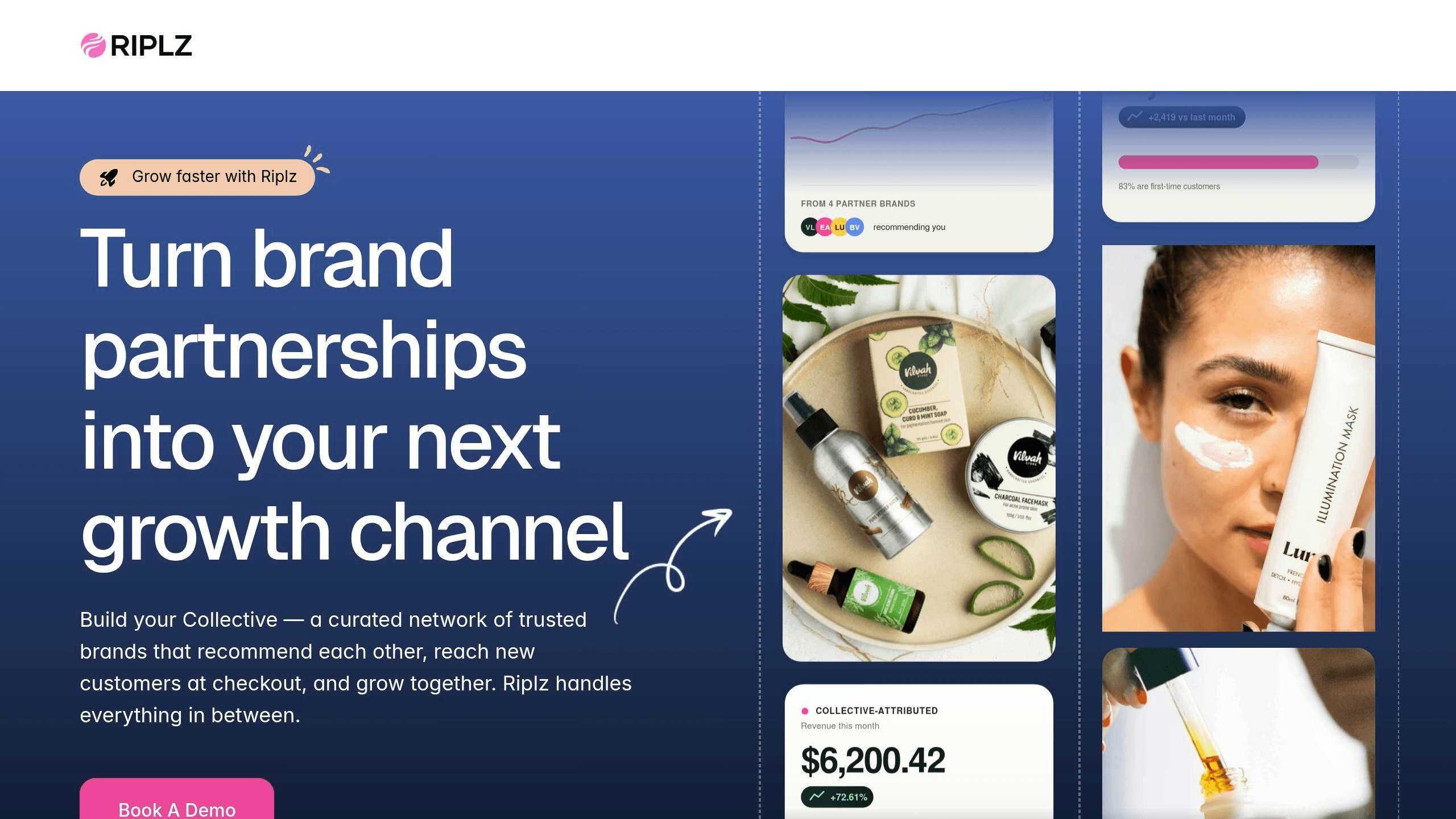
Running manual cross-brand referral campaigns can be a time drain. Riplz simplifies the process by automating partner matching, email capture, and reporting directly on Shopify. One standout feature is its automated partner matching system.
AI-Driven Partner Matching
Choosing the right partner can make or break a cross-brand campaign. Riplz uses AI to take the guesswork out of this process by analyzing factors like non-competing product categories, audience demographics, and shared brand values. For instance, a women-led skincare brand focused on sustainability would be matched with a similarly aligned partner, rather than one from a loosely connected category. This ensures partnerships complement each other without overlapping customer bases, avoiding any risk of cannibalizing sales[2]. By automating this step, Riplz helps create partnerships that feel seamless and trustworthy, making your campaigns more impactful.
Automated Email Capture and Reporting
After launching a referral campaign, Riplz takes over email capture across partner brands. When a customer opts in, their data syncs in real time with tools like Klaviyo, Mailchimp, and Attentive. On top of that, the platform triggers automated email sequences for key referral events, such as "Referral Completed" or "Referral Friend Claim." Reporting is also streamlined: the Basic plan offers per-partner insights, while the Pro plan delivers in-depth analytics. This allows you to see which partnerships are fueling email growth and where adjustments might be needed[13].
Key Metrics to Track Referral-Driven Email Growth
After launching your referral campaigns and setting up automatic email capture, the next step is to evaluate their effectiveness. Keeping an eye on specific metrics will help you understand which partnerships are thriving and which might need rethinking. Here’s a breakdown of the key metrics to assess your campaign’s performance.
Referral Conversion Rate
This metric measures the percentage of referred visitors who actually sign up for your email list. It’s calculated as:
(Referred sign-ups ÷ Referred visitors) × 100
If your conversion rate is consistently at the lower end of the industry average, it might indicate that the partnership isn’t as aligned as it seemed. To track this accurately, provide each partner with a unique UTM-tagged link and a dedicated landing page. This allows you to isolate and analyze their traffic effectively [14].
Cost Per Referred Email
To calculate this, divide your total reward spend (covering both the referrer and the new subscriber) by the number of emails captured. While this expense might seem high initially, referred customers often prove their worth over time. In fact, they have a 37% higher retention rate compared to those acquired through other channels [15]. This makes the cost-per-email metric even more appealing in the long run.
Email Engagement Metrics
Capturing email addresses is just the first step. The real measure of success lies in how engaged those subscribers are. Focus on tracking:
Open rates
Click-through rates (CTR)
Unsubscribe rates
"A smaller list with high engagement (a 'hot' audience) is often better than a large list with low engagement (a 'flat' audience)." - Growth in Reverse [14]
Don’t stop at the first email. Analyze how these subscribers interact with your emails over their first 30–90 days [14]. If they’re regularly opening and clicking, you’ve struck gold. On the other hand, a high early unsubscribe rate could indicate that the partner’s audience isn’t a good match, signaling a need to reassess that partnership before investing further.
Metric | Benchmark |
|---|---|
Referral Conversion Rate | 5%–15% [16] |
Cost Per Referred Email | $10–$20 [16] |
Email Open Rate | ~30% [14] |
Click-Through Rate (CTR) | ~2.3% [14] |
Unsubscribe Rate | 0.1%–0.3% [17] |
Conclusion: Growing Your Email List with Cross-Brand Referrals
Cross-brand referrals bring a level of trust and efficiency that paid ads simply can't match. Instead of pouring money into cold traffic, this strategy lets you tap into audiences that already trust a complementary brand. That trust translates into leads who are more likely to engage before you even send the first email.
Take Harry's, for example. Their pre-launch referral campaign pulled in an impressive 100,000 signups in just one week, with 77% of those coming through referrals [3]. Achieving that kind of traction with paid ads would be nearly impossible - and it came at a much lower cost.
"Partnership marketing isn't just a nice-to-have anymore. It's the secret weapon of brands that scale past $50M without burning through capital." - RISE DTC [18]
What makes this strategy even more appealing is its compound effect. One successful partnership can lead to opportunities with other like-minded brands, creating a self-sustaining network that grows without a steep rise in costs. Tools like Riplz make this process even easier by connecting compatible DTC brands, automating post-checkout email collection, and delivering actionable insights.
To make the most of cross-brand referrals, focus on the essentials: choose partners wisely, monitor the right metrics, and ensure every email feels relevant and engaging from the start. When done right, this approach brings in subscribers who are not just numbers on a list but potential loyal customers. By sticking to a disciplined plan, your DTC brand can consistently grow its email list with high-quality leads.
FAQs
How do I find the right partner brand?
What reward should I offer for referrals?
How do I track referral email performance?
How Cross-Brand Referrals Help Capture More Customer Emails
Cross-brand referrals are a smart way for direct-to-consumer (DTC) brands to grow email lists without relying on expensive paid ads. By teaming up with complementary brands, you can exchange audiences and build trust through shared recommendations. This approach is cost-effective, trust-driven, and works well even in a post-iOS 14.5 world, where ad tracking has become less effective.
Key Takeaways:
What They Are: Two or more non-competing brands collaborate to promote each other’s products, sharing audiences.
Why They Work: Customers trust recommendations from brands they already like. Referral leads are more engaged and loyal, with higher repeat purchase rates (35–42% vs. 20–25% for paid ads).
Cost Advantage: Cross-brand referrals can cut acquisition costs by 20–40% compared to paid ads.
Real-World Results: Harry’s pre-launch campaign gained 100,000 email signups in a week, with 77% from referrals.
How to Start:
Partner with brands that share your audience’s values.
Use tools like post-checkout widgets to capture emails.
Offer two-sided rewards (e.g., discounts or gifts) to incentivize participation.
This method not only grows your subscriber base but also brings in high-quality leads who are more likely to engage with your brand long-term. Tools like Riplz simplify the process by automating partner matching and email capture, making it easier to scale your efforts.
Why Cross-Brand Referrals Work for Email Acquisition
Cross-brand referrals tap into the trust consumers already have for the brands they love. When a company you frequently shop with recommends another, it feels more personal - and far more persuasive - than a random ad popping up in your social media feed.
How Shared Audiences Build Trust
Trust is the driving force behind successful referrals. When two brands align in their values - like sharing a focus on sustainability or wellness - their audiences naturally overlap. This alignment makes referrals feel authentic, not forced.
The numbers tell the story. Research shows that 93% of consumers trust a brand recommended by a friend or family member, while only 38% trust direct advertisements [5]. That’s a massive trust gap, and cross-brand referrals comfortably fall on the trusted side.
"The best cross-promotions don't feel like advertising. They feel like genuine recommendations from brands you trust." - Krunal Vaghasiya, Marketing Tech Expert [1]
Referred leads are also pre-qualified. They shop with similar priorities and care about the same things, which means they’re more likely to engage with your emails once they subscribe. In fact, referred customers often have repeat purchase rates of 35–42%, compared to just 20–25% for customers acquired through paid ads [4]. This trust-driven approach not only increases sign-up rates but also sets the stage for better engagement and loyalty.
Beyond trust, cross-brand referrals also offer a major financial advantage.
Lower Costs Than Paid Ads
Paid advertising comes with ongoing expenses. Every click and impression costs money, and since Apple’s iOS 14.5 update disrupted ad tracking, those costs have risen while effectiveness has dropped.
Cross-brand referrals, on the other hand, allow brands to share audiences and creative resources, generating leads organically without the high costs of ad bidding. Studies show that referral programs can cut Customer Acquisition Costs (CAC) by 20–40% compared to paid media [7].
Factor | Paid Ads | Cross-Brand Referrals |
|---|---|---|
Cost Type | Pay-per-click or impression | Time and resource sharing [1] |
Consumer Trust Level | Low (38% trust) [5] | High (borrowed from partner) [1] |
Audience Quality | Broad, cold traffic | Pre-qualified, values-aligned [2] |
Resilience to Tracking Changes | Highly affected by iOS updates | Unaffected - organic by nature [2] |
As Mailchimp explains:
"This type of endorsement can be more effective than traditional advertising since it comes with an inherent level of trust." [6]
How to Set Up Cross-Brand Referrals for Your DTC Brand
Here’s a practical guide to setting up cross-brand referrals, building on the trust and cost advantages mentioned earlier.
Step 1: Partner with Brands That Share Your Audience and Values
The foundation of a successful cross-brand referral is finding a partner whose audience aligns with yours.
Start by identifying your ideal partner. Think about your core customer: their age, lifestyle, interests, and purchasing habits. For instance, a sustainable activewear company could team up with an eco-friendly supplement brand because their customers likely overlap without competing.
"Values are what draw people to your brand in the first place. Shared values are what will draw your partner's audience to your brand too." - ShopSwap [2]
Jing Gao, Founder and CEO of Fly By Jing, adds:
"We tend to gravitate and vice versa to companies that have similar ethos as us and have similar customer bases as us and also just can work on something just fun with us." - Jing Gao [8]
To ensure the partnership is a good fit, use tools like social listening or surveys to confirm alignment. Before reaching out, define your goals - whether it’s growing your email list, driving sales, or increasing brand awareness - so you can present a clear win-win pitch [9].
Once your partner is on board, it’s time to seamlessly bring their customers into your Shopify ecosystem.
Step 2: Use Post-Checkout Referral Widgets on Shopify
The best time to capture attention is right after a purchase, when customers are most engaged.
"The order confirmation page (thank you page) is your single most valuable referral real estate. Every customer sees it, and they are at peak excitement about their purchase." - JeriCommerce [11]
On Shopify, Plus merchants can use checkout extensibility to customize the thank-you page, while standard merchants can utilize post-purchase apps to add referral widgets. These widgets should be simple: a clear offer, an easy one-click share option, and a way to collect the referred friend’s email during the welcome flow [10][11].
For best results, use a two-sided reward system, ensure the widget works well on mobile, and automate customer tagging through Shopify Flow. Tools like Riplz integrate with Shopify to simplify this process, so you don’t have to build everything from scratch.
Step 3: Launch Incentive-Based Referral Campaigns
Once the system is in place, use incentives to encourage participation. Two-sided rewards - where both the referrer and their friend benefit - tend to work better than one-sided offers.
For example, Myles Apparel adopted a "Give $20, Get $20" model in 2025, which doubled their referral conversions. Referrals made up over 17% of first-time customer growth that quarter [7]. Similarly, Honeylove’s "Give 20%, Get $20" post-checkout prompt boosted Lifetime Value (LTV) by 23% for referred customers compared to other acquisition channels [7].
Another effective approach is running co-branded giveaways. In 2025, Off Road Tents and Guana Equipment collaborated on a rooftop tent giveaway. Entrants had to provide their email and phone number, resulting in over 7,000 high-quality email and SMS subscribers in just 30 days. Many of these leads converted later through exclusive discounts [12].
To make your campaign successful, the incentive should feel worthwhile and easy to access. Match the reward to what your shared audience values, keep the process simple, and promote the campaign wherever customers are most engaged - like the confirmation page, post-purchase emails, and account dashboards.
Riplz Features That Make Referral Campaigns Easier
Running manual cross-brand referral campaigns can be a time drain. Riplz simplifies the process by automating partner matching, email capture, and reporting directly on Shopify. One standout feature is its automated partner matching system.
AI-Driven Partner Matching
Choosing the right partner can make or break a cross-brand campaign. Riplz uses AI to take the guesswork out of this process by analyzing factors like non-competing product categories, audience demographics, and shared brand values. For instance, a women-led skincare brand focused on sustainability would be matched with a similarly aligned partner, rather than one from a loosely connected category. This ensures partnerships complement each other without overlapping customer bases, avoiding any risk of cannibalizing sales[2]. By automating this step, Riplz helps create partnerships that feel seamless and trustworthy, making your campaigns more impactful.
Automated Email Capture and Reporting
After launching a referral campaign, Riplz takes over email capture across partner brands. When a customer opts in, their data syncs in real time with tools like Klaviyo, Mailchimp, and Attentive. On top of that, the platform triggers automated email sequences for key referral events, such as "Referral Completed" or "Referral Friend Claim." Reporting is also streamlined: the Basic plan offers per-partner insights, while the Pro plan delivers in-depth analytics. This allows you to see which partnerships are fueling email growth and where adjustments might be needed[13].
Key Metrics to Track Referral-Driven Email Growth
After launching your referral campaigns and setting up automatic email capture, the next step is to evaluate their effectiveness. Keeping an eye on specific metrics will help you understand which partnerships are thriving and which might need rethinking. Here’s a breakdown of the key metrics to assess your campaign’s performance.
Referral Conversion Rate
This metric measures the percentage of referred visitors who actually sign up for your email list. It’s calculated as:
(Referred sign-ups ÷ Referred visitors) × 100
If your conversion rate is consistently at the lower end of the industry average, it might indicate that the partnership isn’t as aligned as it seemed. To track this accurately, provide each partner with a unique UTM-tagged link and a dedicated landing page. This allows you to isolate and analyze their traffic effectively [14].
Cost Per Referred Email
To calculate this, divide your total reward spend (covering both the referrer and the new subscriber) by the number of emails captured. While this expense might seem high initially, referred customers often prove their worth over time. In fact, they have a 37% higher retention rate compared to those acquired through other channels [15]. This makes the cost-per-email metric even more appealing in the long run.
Email Engagement Metrics
Capturing email addresses is just the first step. The real measure of success lies in how engaged those subscribers are. Focus on tracking:
Open rates
Click-through rates (CTR)
Unsubscribe rates
"A smaller list with high engagement (a 'hot' audience) is often better than a large list with low engagement (a 'flat' audience)." - Growth in Reverse [14]
Don’t stop at the first email. Analyze how these subscribers interact with your emails over their first 30–90 days [14]. If they’re regularly opening and clicking, you’ve struck gold. On the other hand, a high early unsubscribe rate could indicate that the partner’s audience isn’t a good match, signaling a need to reassess that partnership before investing further.
Metric | Benchmark |
|---|---|
Referral Conversion Rate | 5%–15% [16] |
Cost Per Referred Email | $10–$20 [16] |
Email Open Rate | ~30% [14] |
Click-Through Rate (CTR) | ~2.3% [14] |
Unsubscribe Rate | 0.1%–0.3% [17] |
Conclusion: Growing Your Email List with Cross-Brand Referrals
Cross-brand referrals bring a level of trust and efficiency that paid ads simply can't match. Instead of pouring money into cold traffic, this strategy lets you tap into audiences that already trust a complementary brand. That trust translates into leads who are more likely to engage before you even send the first email.
Take Harry's, for example. Their pre-launch referral campaign pulled in an impressive 100,000 signups in just one week, with 77% of those coming through referrals [3]. Achieving that kind of traction with paid ads would be nearly impossible - and it came at a much lower cost.
"Partnership marketing isn't just a nice-to-have anymore. It's the secret weapon of brands that scale past $50M without burning through capital." - RISE DTC [18]
What makes this strategy even more appealing is its compound effect. One successful partnership can lead to opportunities with other like-minded brands, creating a self-sustaining network that grows without a steep rise in costs. Tools like Riplz make this process even easier by connecting compatible DTC brands, automating post-checkout email collection, and delivering actionable insights.
To make the most of cross-brand referrals, focus on the essentials: choose partners wisely, monitor the right metrics, and ensure every email feels relevant and engaging from the start. When done right, this approach brings in subscribers who are not just numbers on a list but potential loyal customers. By sticking to a disciplined plan, your DTC brand can consistently grow its email list with high-quality leads.
FAQs
How do I find the right partner brand?
What reward should I offer for referrals?
How do I track referral email performance?
Bring Passion. Get Growth, Support.


Where Ecommerce Brands Grow Together
Riplz connects values-aligned brands into Collectives that drive emails, sales, and lasting customer relationships
Book a Demo
Where Ecommerce Brands Grow Together
Riplz connects values-aligned brands into Collectives that drive emails, sales, and lasting customer relationships
Book a Demo
Where Ecommerce Brands Grow Together
Riplz connects values-aligned brands into Collectives that drive emails, sales, and lasting customer relationships
Book a Demo