
Marketing
7 Ways Ecommerce Brands Can Grow Through Partnerships
Partnerships are a cost-effective growth channel for ecommerce—use collaborations, affiliates, cross-promos, post-checkout offers and events to cut CAC.
7 Ways Ecommerce Brands Can Grow Through Partnerships
Ecommerce brands are facing rising costs, with customer acquisition expenses up 60% in the past five years [1]. Traditional ads are less effective, and partnerships offer a cost-efficient way to grow by leveraging trust and shared audiences. Here are some highly impactful ways partnerships can help:
Collaborate with complementary brands to reach new audiences.
Share resources and expertise to create better products or services.
Launch co-branded products to expand offerings without high R&D costs.
Use affiliate programs to pay only for results, reducing risks.
Run cross-promotions to engage new customers without extra ad spend.
Leverage post-checkout tools like Riplz to acquire customers efficiently.
Host events or create exclusive programs to build stronger customer loyalty.
These strategies help ecommerce businesses drive growth while minimizing costs and risks. Start small with pilot programs, track results, and scale successful collaborations.
1. Reach More Customers by Partnering with Complementary Brands
Teaming up with a brand that doesn't compete directly but shares a similar audience can be a game-changer. Think about it: a coffee company joining forces with a mug manufacturer, or a mattress business collaborating with a furniture retailer. The target customers overlap, but the products serve different needs, making the partnership seamless.
What's the real advantage here? By working with an established brand, you can tap into their credibility and audience trust, leading to better engagement. Plus, it's cost-effective. Collaborations like these can cost up to 25 times less than traditional digital ads while delivering similar results [2].
Here's a great example: the toy brand PlanToys used Shopify Collective to sell through partner retailers in 2022. The results? In November of that year, 18% of their orders and 4.5% of their total revenue came from this partnership channel [3].
"Partner marketing is all about value exchange. Even relatively small companies can connect with other brands to forge meaningful collaborations that create buzz and expand their reach." — Shopify Staff [3]
This approach is not only affordable but also low-risk. Start small - try a 3-to-6-month pilot with a limited product selection. Use this time to test the waters and see how well your audiences align. Surveys can help pinpoint potential partners that resonate most with your customers before diving into a long-term commitment.
2. Share Expertise and Resources with Partner Brands
Working with a complementary brand isn't just about expanding your audience — it's about achieving more by combining strengths. When two brands bring together their expertise, tools, and distribution channels, they can accomplish things that might be difficult or even impossible to do alone.
Take Adidas and Allbirds in 2021. These two companies joined forces to create the "Futurecraft.Footprint" running shoe, a product with an impressively low carbon footprint of just 2.94 kg CO2e. By pooling their R&D resources, they achieved something remarkable — the limited release of 100 pairs sold out almost instantly [3]. Partnerships like this don't just save costs — like sharing expenses for email campaigns or webinars — they also allow brands to tap into each other's trusted audiences. This often results in more qualified leads compared to those generated through traditional advertising.
"The stores that are actually growing aren't playing that game [expensive ads] anymore. They've figured out that partnerships… might be the most underutilized marketing channel in the industry." — Syncio [4]
Additionally, using shared dashboards in tools like Google Analytics or Looker helps both you and your brand partners track results and measure success. By combining expertise and leveraging efficient systems, you can grow together. while laying the groundwork for future partnerships.
3. Grow Your Product Line with Co-Branded Offerings
Co-branded products let you expand your lineup by combining strengths with another brand — without shouldering the full cost of solo R&D. A great example? Fishwife Tinned Seafood Co. and Fly By Jing teamed up to create "The Fly By Jing Smoked Salmon," blending Fishwife's Fairtrade salmon from Kvarøy Arctic with Fly By Jing's iconic Sichuan chilli crisp — something neither brand could have achieved alone [2].
Collaboration often pays off. According to Deloitte's 2026 Consumer Products report, “73% of retailers and consumer products companies reported increased commercial collaboration, and 86% of those said it increased sales” [3]. It's a smart move with relatively low risk. Plus, co-branded launches double as market tests: a limited-edition product — a single SKU available for 3 to 6 months — can help you gauge interest in a new category before committing to full-scale production. The built-in scarcity creates urgency and buzz without discounting your current products.
"Our dream was to work with Nike: their legacy, innovation and athlete insights — it was the perfect thing to mix with Skims, and our dedication to the female form." — Kim Kardashian, Founder, Skims [5]
Kim Kardashian's collaboration with Nike highlights how the right partner can elevate both brands. To pull off a successful co-branding effort, survey your customers to identify brands they already trust. When reaching out to a potential partner, clearly outline the benefits — like shared costs, access to each other's audiences, and a fresh product idea. Uri Weinberger emphasizes this approach:
"Be transparent and when you're going to the negotiating table, be up front and say, 'This has to work within these parameters.'" [5]
Before launching, nail down the details: who handles production, shipping, and customer service? How will revenue be split? Clear agreements set the stage for smooth collaboration.
4. Use Affiliate Partnerships to Tie Growth to Results
Affiliate programs flip the traditional advertising model on its head. Instead of paying upfront, you only pay affiliates when they deliver a sale or lead — significantly reducing risk. By 2026, affiliate marketing is expected to account for $1 out of every $7 in US ecommerce sales [6].
But the benefits go beyond cost savings. Affiliates — whether bloggers, influencers, or niche publishers — often have loyal audiences that trust them, and trust is a powerful driver of conversions. In fact, 92% of consumers trust recommendations from friends, family, and online experts more than traditional ads [7]. When an affiliate endorses your product, it resonates differently than a generic banner ad.
Take Solo Stove as an example. Between 2021 and 2023, the outdoor brand focused on a content-driven affiliate strategy, partnering with lifestyle and outdoor creators. The result? A 72% boost in affiliate revenue and an 85% improvement in ROAS, all while spending 7% less on affiliates [8]. Another success story comes from Moonboon, a baby accessory company. Using Shopify Collabs, they managed over 300 vetted creators across five European markets, driving over $1 million in sales — roughly 10% of their monthly net sales — with a 6.5x return on investment [6][9].
If you have a product that can be talked about in publications, if you're not on an affiliate platform, you are completely losing out on really maximising all the press opportunities for the brand." — Lauren Kleinman, Founder, Dreamday [6]
To get started, define your KPIs upfront (CAC, ROAS, referral traffic). If you're on Shopify, Shopify Collabs is a natural fit; for broader access to pre-vetted publishers, platforms like impact.com or Awin work well.
Consider a tiered commission structure — starting at 5% for new affiliates and increasing to 10–20% as they hit performance milestones. Most brands find a 30-day cookie window sufficient, but for high-ticket items like furniture, extending it to 60–90 days ensures affiliates are fairly credited for longer decision cycles [6].
"The most successful programs prioritize long-term alignment with partners over one-off activations — relationships scale, transactions don't." — Jason Perumal, Affiliate Marketing Content Manager, impact.com [8]
Affiliate marketing isn’t just about driving sales - it’s about building sustainable, performance-driven relationships. With this strategy in place, the next step is to explore additional ways to expand your network of strategic partnerships.
5. Run Cross-Promotions to Reach Each Other's Audiences
Cross-promotions are one of the most efficient ways to expand your customer base without increasing ad spend. Two brands with overlapping but non-competing audiences promote each other, tapping into existing trust and reach so both benefit. According to Deloitte's 2026 Consumer Products report — cited via Shopify — 73% of retailers reported more commercial partnerships in 2026, and 86% of those saw increased sales [3].
There are several ways to implement cross-promotions, each serving a specific purpose:
Email swaps: These are great for generating high-quality leads, as they target people who already trust the brand they're subscribed to.
Social shoutouts: Perfect for increasing brand awareness.
Product bundles: These encourage larger purchases by combining complementary products.
Collaborative giveaways: Ideal for quickly growing email lists, as participants usually provide their contact information to enter.
Here's a real-world example: In 2025, Off Road Tents and Guana Equipment teamed up for a 30-day rooftop tent giveaway. Participants entered by submitting their email and phone number, and the campaign brought in over 7,000 high-quality leads — with sales boosted by exclusive discount codes sent to entrants [5]. Impressive results at a fraction of the cost of comparable paid media.
Another effective tactic is a gift-with-purchase insert — adding a partner brand's sample to outgoing orders. It gets a physical product into the hands of customers already in a buying mindset. A QR code linking to a landing page can track conversions and collect emails even if the recipient doesn't buy immediately.
To set up a cross-promotion, start by identifying a non-competing partner with a similar audience, document all terms clearly, and use UTM parameters on shared links to track performance. Test with a small initiative first — a giveaway or email swap — before scaling up.
"We tend to gravitate to companies that have similar ethos as us and have similar customer bases... Does this make sense? Are we aligned in terms of our communities?" - Jing Gao, Founder and CEO, Fly By Jing [6]
6. Use Riplz to Acquire Customers After Checkout
Most partnership strategies can be a hassle to coordinate — juggling schedules, drafting campaigns, hammering out terms. Riplz flips the script by transforming the post-checkout moment into an automated customer acquisition tool for Shopify-based DTC brands, working seamlessly alongside your existing partnership strategies.
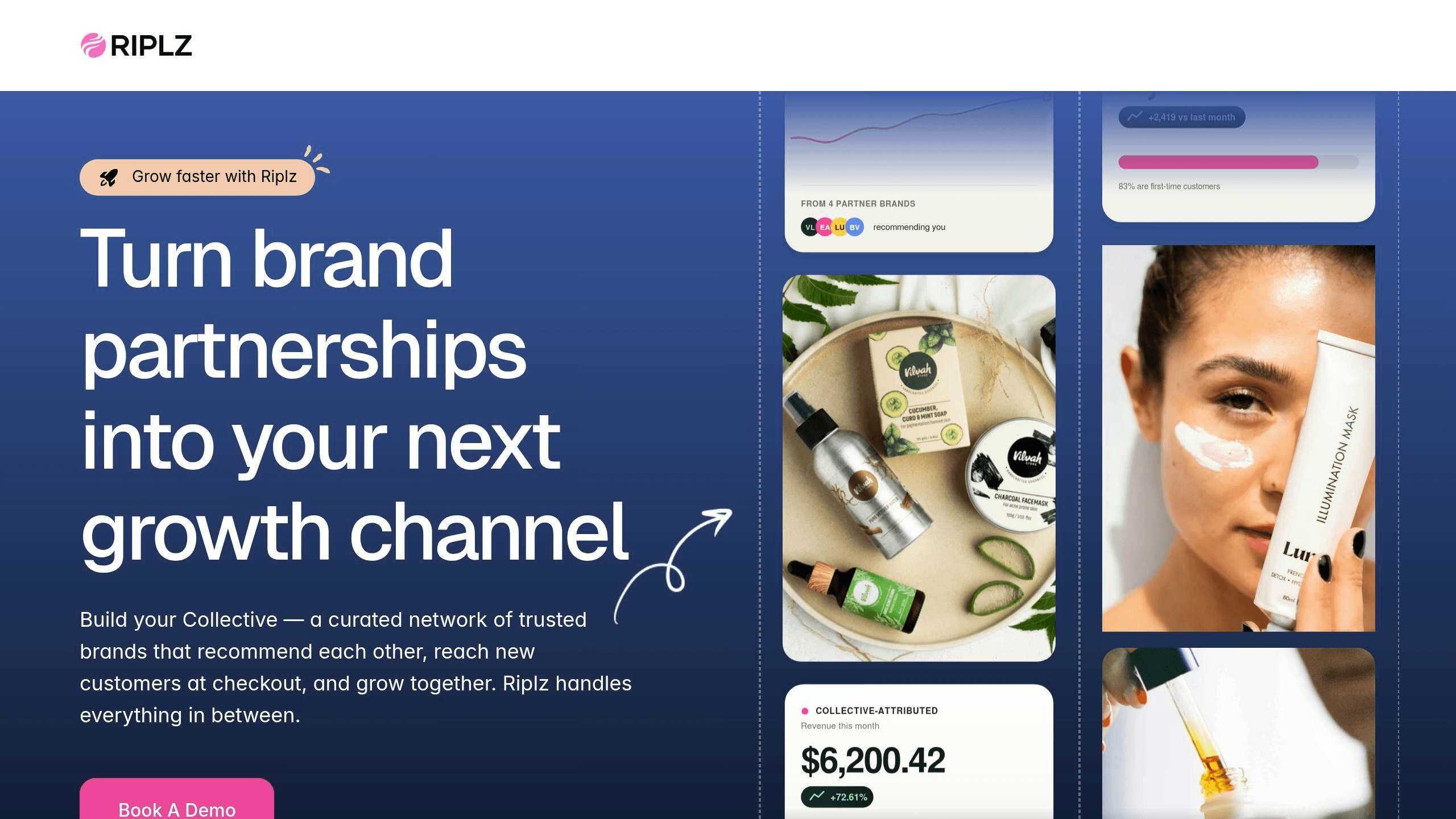
Here's the idea: right after a customer makes a purchase, their trust and intent are at their highest [10]. That's when Riplz steps in, introducing them to a partner brand's offer. Imagine a sustainable skincare brand being featured on the confirmation page of a women-led activewear store — since the customer just purchased, they're far more likely to engage than with a cold social ad.
What makes this stand out is cost-effectiveness. 92% of consumers trust recommendations from peers and experts over standard ads [7]. By leveraging partnerships, brands tap into that trust without the hefty price tag of CPM-based campaigns. Research across thousands of Shopify stores indicates that systematic growth initiatives can improve key business metrics by 15–35%, highlighting the value of scalable partnership and marketing programs. [11]
Riplz also grows with your network. Its AI-driven matching system connects you with values-aligned brands, while built-in performance tracking identifies which partnerships deliver results. Integration with Shopify requires no developers. It's a perfect complement to your existing cross-promotions and affiliate programmes.
7. Build Brand Communities Through Events and Exclusive Access
Partnerships don't have to stay digital. Some of the most impactful collaborations happen in person — or through exclusive programmes that make customers feel like insiders. When brands create shared experiences, they tap into something paid ads can't replicate: genuine loyalty.
In November 2025, skincare brand Klean joined forces with matcha brand Jenki to host a workshop and set up a branded matcha truck in London. They served iced lattes and handed out product samples to beauty-conscious, health-focused shoppers — a low-cost activation that connected both brands with a shared audience memorably [12]. Similarly, Leesa partnered with West Elm by placing mattresses in West Elm's showrooms, letting potential buyers experience the product in a realistic bedroom setting — a smart move for an online-first brand building trust [3].
These live activations are also budget-friendly. Nano-influencer posts can cost as little as $10–$100 [6], and sharing resources with a partner stretches your marketing dollars further. A 3-to-6-month pilot programme lets you figure out what works before committing to something bigger [12], and QR codes at events help connect offline efforts to measurable online results.
If you want to go beyond one-time events, consider member perks portals — loyalty areas featuring ongoing partner offers. This shifts your strategy from short-term campaigns to continuous engagement and builds retention without constant new launches. The numbers back this up: 77% of companies in co-branding partnerships report increased profits [13], and per Deloitte's 2026 data, 86% of those that boosted collaboration saw higher sales [3].
"The most successful programs prioritize long-term alignment with partners over one-off activations - long-term relationships drive sustainable growth." - Jason Perumal, Affiliate Marketing Content Manager, impact.com [8]
Whether it’s a collaborative workshop, a pop-up event, or a members-only perks program, the goal is to create a deeper connection with your customers. That sense of belonging transforms casual buyers into loyal advocates for your brand.
Conclusion
Growing through partnerships involves a variety of approaches, each targeting a unique aspect of your business. The seven strategies here offer diverse ways to strengthen your growth engine: complementary brand partnerships broaden your audience; shared resources reduce costs; co-branded products create fresh revenue; affiliate programmes tie spend to results; cross-promotions unlock engaged new audiences; tools like Riplz turn post-checkout moments into acquisition opportunities; and live events or member perks build the kind of loyalty that advertising alone can't achieve.
Your timeline for achieving an effective partnership may look something like this: Start by identifying 2–5 potential partner brands. Reach out within a week, aim to finalise agreements in two weeks, and launch a pilot collaboration within 30 days.
"The challenge isn't simply finding partners — it's knowing which types of partnerships will drive real results for your specific business goals." [8]
According to Deloitte's 2026 Consumer Products report, 73% of retailers reported more commercial collaboration, and 86% of those saw higher sales as a result [3]. By leveraging trusted partnerships, you create a scalable, cost-effective way to drive growth across every part of your operation.
FAQs
How do I pick the right partner brand?
What should a partnership agreement include?
Which KPIs should I track for partnerships?
7 Ways Ecommerce Brands Can Grow Through Partnerships
Ecommerce brands are facing rising costs, with customer acquisition expenses up 60% in the past five years [1]. Traditional ads are less effective, and partnerships offer a cost-efficient way to grow by leveraging trust and shared audiences. Here are some highly impactful ways partnerships can help:
Collaborate with complementary brands to reach new audiences.
Share resources and expertise to create better products or services.
Launch co-branded products to expand offerings without high R&D costs.
Use affiliate programs to pay only for results, reducing risks.
Run cross-promotions to engage new customers without extra ad spend.
Leverage post-checkout tools like Riplz to acquire customers efficiently.
Host events or create exclusive programs to build stronger customer loyalty.
These strategies help ecommerce businesses drive growth while minimizing costs and risks. Start small with pilot programs, track results, and scale successful collaborations.
1. Reach More Customers by Partnering with Complementary Brands
Teaming up with a brand that doesn't compete directly but shares a similar audience can be a game-changer. Think about it: a coffee company joining forces with a mug manufacturer, or a mattress business collaborating with a furniture retailer. The target customers overlap, but the products serve different needs, making the partnership seamless.
What's the real advantage here? By working with an established brand, you can tap into their credibility and audience trust, leading to better engagement. Plus, it's cost-effective. Collaborations like these can cost up to 25 times less than traditional digital ads while delivering similar results [2].
Here's a great example: the toy brand PlanToys used Shopify Collective to sell through partner retailers in 2022. The results? In November of that year, 18% of their orders and 4.5% of their total revenue came from this partnership channel [3].
"Partner marketing is all about value exchange. Even relatively small companies can connect with other brands to forge meaningful collaborations that create buzz and expand their reach." — Shopify Staff [3]
This approach is not only affordable but also low-risk. Start small - try a 3-to-6-month pilot with a limited product selection. Use this time to test the waters and see how well your audiences align. Surveys can help pinpoint potential partners that resonate most with your customers before diving into a long-term commitment.
2. Share Expertise and Resources with Partner Brands
Working with a complementary brand isn't just about expanding your audience — it's about achieving more by combining strengths. When two brands bring together their expertise, tools, and distribution channels, they can accomplish things that might be difficult or even impossible to do alone.
Take Adidas and Allbirds in 2021. These two companies joined forces to create the "Futurecraft.Footprint" running shoe, a product with an impressively low carbon footprint of just 2.94 kg CO2e. By pooling their R&D resources, they achieved something remarkable — the limited release of 100 pairs sold out almost instantly [3]. Partnerships like this don't just save costs — like sharing expenses for email campaigns or webinars — they also allow brands to tap into each other's trusted audiences. This often results in more qualified leads compared to those generated through traditional advertising.
"The stores that are actually growing aren't playing that game [expensive ads] anymore. They've figured out that partnerships… might be the most underutilized marketing channel in the industry." — Syncio [4]
Additionally, using shared dashboards in tools like Google Analytics or Looker helps both you and your brand partners track results and measure success. By combining expertise and leveraging efficient systems, you can grow together. while laying the groundwork for future partnerships.
3. Grow Your Product Line with Co-Branded Offerings
Co-branded products let you expand your lineup by combining strengths with another brand — without shouldering the full cost of solo R&D. A great example? Fishwife Tinned Seafood Co. and Fly By Jing teamed up to create "The Fly By Jing Smoked Salmon," blending Fishwife's Fairtrade salmon from Kvarøy Arctic with Fly By Jing's iconic Sichuan chilli crisp — something neither brand could have achieved alone [2].
Collaboration often pays off. According to Deloitte's 2026 Consumer Products report, “73% of retailers and consumer products companies reported increased commercial collaboration, and 86% of those said it increased sales” [3]. It's a smart move with relatively low risk. Plus, co-branded launches double as market tests: a limited-edition product — a single SKU available for 3 to 6 months — can help you gauge interest in a new category before committing to full-scale production. The built-in scarcity creates urgency and buzz without discounting your current products.
"Our dream was to work with Nike: their legacy, innovation and athlete insights — it was the perfect thing to mix with Skims, and our dedication to the female form." — Kim Kardashian, Founder, Skims [5]
Kim Kardashian's collaboration with Nike highlights how the right partner can elevate both brands. To pull off a successful co-branding effort, survey your customers to identify brands they already trust. When reaching out to a potential partner, clearly outline the benefits — like shared costs, access to each other's audiences, and a fresh product idea. Uri Weinberger emphasizes this approach:
"Be transparent and when you're going to the negotiating table, be up front and say, 'This has to work within these parameters.'" [5]
Before launching, nail down the details: who handles production, shipping, and customer service? How will revenue be split? Clear agreements set the stage for smooth collaboration.
4. Use Affiliate Partnerships to Tie Growth to Results
Affiliate programs flip the traditional advertising model on its head. Instead of paying upfront, you only pay affiliates when they deliver a sale or lead — significantly reducing risk. By 2026, affiliate marketing is expected to account for $1 out of every $7 in US ecommerce sales [6].
But the benefits go beyond cost savings. Affiliates — whether bloggers, influencers, or niche publishers — often have loyal audiences that trust them, and trust is a powerful driver of conversions. In fact, 92% of consumers trust recommendations from friends, family, and online experts more than traditional ads [7]. When an affiliate endorses your product, it resonates differently than a generic banner ad.
Take Solo Stove as an example. Between 2021 and 2023, the outdoor brand focused on a content-driven affiliate strategy, partnering with lifestyle and outdoor creators. The result? A 72% boost in affiliate revenue and an 85% improvement in ROAS, all while spending 7% less on affiliates [8]. Another success story comes from Moonboon, a baby accessory company. Using Shopify Collabs, they managed over 300 vetted creators across five European markets, driving over $1 million in sales — roughly 10% of their monthly net sales — with a 6.5x return on investment [6][9].
If you have a product that can be talked about in publications, if you're not on an affiliate platform, you are completely losing out on really maximising all the press opportunities for the brand." — Lauren Kleinman, Founder, Dreamday [6]
To get started, define your KPIs upfront (CAC, ROAS, referral traffic). If you're on Shopify, Shopify Collabs is a natural fit; for broader access to pre-vetted publishers, platforms like impact.com or Awin work well.
Consider a tiered commission structure — starting at 5% for new affiliates and increasing to 10–20% as they hit performance milestones. Most brands find a 30-day cookie window sufficient, but for high-ticket items like furniture, extending it to 60–90 days ensures affiliates are fairly credited for longer decision cycles [6].
"The most successful programs prioritize long-term alignment with partners over one-off activations — relationships scale, transactions don't." — Jason Perumal, Affiliate Marketing Content Manager, impact.com [8]
Affiliate marketing isn’t just about driving sales - it’s about building sustainable, performance-driven relationships. With this strategy in place, the next step is to explore additional ways to expand your network of strategic partnerships.
5. Run Cross-Promotions to Reach Each Other's Audiences
Cross-promotions are one of the most efficient ways to expand your customer base without increasing ad spend. Two brands with overlapping but non-competing audiences promote each other, tapping into existing trust and reach so both benefit. According to Deloitte's 2026 Consumer Products report — cited via Shopify — 73% of retailers reported more commercial partnerships in 2026, and 86% of those saw increased sales [3].
There are several ways to implement cross-promotions, each serving a specific purpose:
Email swaps: These are great for generating high-quality leads, as they target people who already trust the brand they're subscribed to.
Social shoutouts: Perfect for increasing brand awareness.
Product bundles: These encourage larger purchases by combining complementary products.
Collaborative giveaways: Ideal for quickly growing email lists, as participants usually provide their contact information to enter.
Here's a real-world example: In 2025, Off Road Tents and Guana Equipment teamed up for a 30-day rooftop tent giveaway. Participants entered by submitting their email and phone number, and the campaign brought in over 7,000 high-quality leads — with sales boosted by exclusive discount codes sent to entrants [5]. Impressive results at a fraction of the cost of comparable paid media.
Another effective tactic is a gift-with-purchase insert — adding a partner brand's sample to outgoing orders. It gets a physical product into the hands of customers already in a buying mindset. A QR code linking to a landing page can track conversions and collect emails even if the recipient doesn't buy immediately.
To set up a cross-promotion, start by identifying a non-competing partner with a similar audience, document all terms clearly, and use UTM parameters on shared links to track performance. Test with a small initiative first — a giveaway or email swap — before scaling up.
"We tend to gravitate to companies that have similar ethos as us and have similar customer bases... Does this make sense? Are we aligned in terms of our communities?" - Jing Gao, Founder and CEO, Fly By Jing [6]
6. Use Riplz to Acquire Customers After Checkout
Most partnership strategies can be a hassle to coordinate — juggling schedules, drafting campaigns, hammering out terms. Riplz flips the script by transforming the post-checkout moment into an automated customer acquisition tool for Shopify-based DTC brands, working seamlessly alongside your existing partnership strategies.
Here's the idea: right after a customer makes a purchase, their trust and intent are at their highest [10]. That's when Riplz steps in, introducing them to a partner brand's offer. Imagine a sustainable skincare brand being featured on the confirmation page of a women-led activewear store — since the customer just purchased, they're far more likely to engage than with a cold social ad.
What makes this stand out is cost-effectiveness. 92% of consumers trust recommendations from peers and experts over standard ads [7]. By leveraging partnerships, brands tap into that trust without the hefty price tag of CPM-based campaigns. Research across thousands of Shopify stores indicates that systematic growth initiatives can improve key business metrics by 15–35%, highlighting the value of scalable partnership and marketing programs. [11]
Riplz also grows with your network. Its AI-driven matching system connects you with values-aligned brands, while built-in performance tracking identifies which partnerships deliver results. Integration with Shopify requires no developers. It's a perfect complement to your existing cross-promotions and affiliate programmes.
7. Build Brand Communities Through Events and Exclusive Access
Partnerships don't have to stay digital. Some of the most impactful collaborations happen in person — or through exclusive programmes that make customers feel like insiders. When brands create shared experiences, they tap into something paid ads can't replicate: genuine loyalty.
In November 2025, skincare brand Klean joined forces with matcha brand Jenki to host a workshop and set up a branded matcha truck in London. They served iced lattes and handed out product samples to beauty-conscious, health-focused shoppers — a low-cost activation that connected both brands with a shared audience memorably [12]. Similarly, Leesa partnered with West Elm by placing mattresses in West Elm's showrooms, letting potential buyers experience the product in a realistic bedroom setting — a smart move for an online-first brand building trust [3].
These live activations are also budget-friendly. Nano-influencer posts can cost as little as $10–$100 [6], and sharing resources with a partner stretches your marketing dollars further. A 3-to-6-month pilot programme lets you figure out what works before committing to something bigger [12], and QR codes at events help connect offline efforts to measurable online results.
If you want to go beyond one-time events, consider member perks portals — loyalty areas featuring ongoing partner offers. This shifts your strategy from short-term campaigns to continuous engagement and builds retention without constant new launches. The numbers back this up: 77% of companies in co-branding partnerships report increased profits [13], and per Deloitte's 2026 data, 86% of those that boosted collaboration saw higher sales [3].
"The most successful programs prioritize long-term alignment with partners over one-off activations - long-term relationships drive sustainable growth." - Jason Perumal, Affiliate Marketing Content Manager, impact.com [8]
Whether it’s a collaborative workshop, a pop-up event, or a members-only perks program, the goal is to create a deeper connection with your customers. That sense of belonging transforms casual buyers into loyal advocates for your brand.
Conclusion
Growing through partnerships involves a variety of approaches, each targeting a unique aspect of your business. The seven strategies here offer diverse ways to strengthen your growth engine: complementary brand partnerships broaden your audience; shared resources reduce costs; co-branded products create fresh revenue; affiliate programmes tie spend to results; cross-promotions unlock engaged new audiences; tools like Riplz turn post-checkout moments into acquisition opportunities; and live events or member perks build the kind of loyalty that advertising alone can't achieve.
Your timeline for achieving an effective partnership may look something like this: Start by identifying 2–5 potential partner brands. Reach out within a week, aim to finalise agreements in two weeks, and launch a pilot collaboration within 30 days.
"The challenge isn't simply finding partners — it's knowing which types of partnerships will drive real results for your specific business goals." [8]
According to Deloitte's 2026 Consumer Products report, 73% of retailers reported more commercial collaboration, and 86% of those saw higher sales as a result [3]. By leveraging trusted partnerships, you create a scalable, cost-effective way to drive growth across every part of your operation.
FAQs
How do I pick the right partner brand?
What should a partnership agreement include?
Which KPIs should I track for partnerships?
Bring Passion. Get Growth, Support.


Where Ecommerce Brands Grow Together
Riplz connects values-aligned brands into Collectives that drive emails, sales, and lasting customer relationships
Book a Demo
Where Ecommerce Brands Grow Together
Riplz connects values-aligned brands into Collectives that drive emails, sales, and lasting customer relationships
Book a Demo
Where Ecommerce Brands Grow Together
Riplz connects values-aligned brands into Collectives that drive emails, sales, and lasting customer relationships
Book a Demo