
Marketing
The Role of Trust in Post-Checkout Brand Discovery
The moment right after checkout is when customer trust peaks. Here's why that makes it the ideal place to build a Collective Acquisition Channel.
The Role of Trust in Post-Checkout Brand Discovery
When 45% of customers voluntarily opted into a Collective Acquisition Channel after completing a purchase, the obvious interpretation was that the offer converted well.
That interpretation is accurate. It is also the least interesting thing about the number.
A conversion rate tells us what people did. A useful product analysis asks why the decision made sense to them at that particular moment, inside that particular relationship, with that particular request.
Across seven participating DTC brands, 45% of eligible customers chose to join a Collective after checkout. 40% clicked through to explore a participating partner brand. More than 2,000 customer emails were generated through the experience. These are Riplz platform observations, not projections or survey responses.
The opt-in rate is evidence that customer permission is not a fixed trait. It is contextual. People are not simply “willing” or “unwilling” to subscribe, share information, explore another brand, or accept a recommendation. Their response depends on who is asking, why the request is being made, what just happened, and whether the next action feels consistent with the experience they chose.
That is a product architecture problem disguised as a marketing metric.
The transaction changes the meaning of the request
Before checkout, the customer is still evaluating risk.
They are judging the product, the price, the brand, the delivery promise, the return policy, and whether the entire site looks as though it was assembled by adults. Every additional request competes with the primary job: deciding whether to buy.
After checkout, the relationship has changed. The customer has selected the brand, paid for the product, and received confirmation that the transaction succeeded. The brand is no longer an unknown merchant asking for attention. It is the company the customer just trusted with money, personal information, and the expectation that something will arrive at their home.
That does not mean the customer has entered a temporary state of marketing hypnosis. It means the interaction has acquired context.
The next request is interpreted through the decision that immediately preceded it. A post-checkout invitation from the brand a customer just chose does not carry the same meaning as a pop-up shown three seconds after the customer arrived from a search result. The interface may contain the same email field and the same button, but behaviorally, they are different products.
This is why optimizing the words on the button while ignoring the moment around it misses most of the problem.
What is a Collective Acquisition Channel?
A Collective Acquisition Channel is a customer-acquisition model in which aligned brands help customers discover one another through trusted, customer-facing relationships rather than through conventional paid targeting.
In the Riplz experience, a customer may encounter a Collective placement after purchasing from a participating brand. The invitation connects that purchase to a curated group of other brands organized around a relevant shared theme.
The important product principle is not that something appears after checkout. Plenty of things appear after checkout. Most of them are order numbers, shipping details, account prompts, upsells, surveys, referral requests, app-download pitches, and whatever else the growth team managed to fit onto the page before someone from UX noticed.
The principle is that the invitation must feel like a coherent continuation of the transaction. Context does not merely surround the choice. Context helps determine what the choice means.
Trust is transferred through experience, not borrowed through placement
Trust is often discussed as though it were a decorative brand attribute: establish credibility, add social proof, use reassuring typography, and perhaps stick a shield icon somewhere near the credit-card form.
Actual trust is more demanding. Deepa Prahalad wrote in Harvard Business Review that trust is “not simply a nice thing to have, but a critical strategic asset.” [1]
The useful word there is asset. Trust produces value because it changes how people assess uncertainty. It reduces the amount of independent verification required before they act.
That is particularly relevant when one brand introduces another. The originating brand is not automatically entitled to transfer customer trust to every company willing to participate. A recommendation can strengthen trust when it feels selective and appropriate. It can also spend that trust rather quickly when the recommendation is irrelevant, excessive, or transparently transactional.
Baymard Institute’s large-scale usability research found that suggesting products without an obvious relationship to the cart “can erode a user’s confidence in the site, and all of its recommendations — even relevant ones.” [2]
That erosion reaches beyond the irrelevant recommendation itself. Baymard notes that it can undermine confidence in relevant recommendations too.
This is the expensive part of getting curation wrong. A poorly matched placement does not merely fail to convert. It teaches the customer that the surrounding recommendation system is not worth their attention.
The 45% opt-in rate therefore cannot be explained by location alone. Post-checkout created the opportunity, but relevance and curation helped make the invitation credible.

The customer must understand why the invitation belongs there
In customer interviews I conducted for Riplz, 91% of participants said they preferred discovering new brands through brands they already trusted. Every participant encountered at least one brand they had not previously known, and every participant expressed interest or openness to discovering new brands through the Collective.
Those results support a straightforward behavioral model:
Known brand + relevant context + credible curation = lower uncertainty around unfamiliar brands.
The known brand provides the starting trust. The shared theme explains why the brands appear together. The curation implies that someone exercised judgment instead of simply selling the available space.
The incentive still matters. In five detailed interviews, every participant said both the shared theme and the opportunity to save mattered. Customers do not become morally opposed to discounts simply because the experience has a coherent narrative.
But the incentive was not operating alone. One participant described the post-purchase experience this way:
“It felt like it was a natural conversion, not a marketing push.”
Another called it “seamless.”
The second comment is particularly irritating to a product person because “seamless” is the word everyone uses when they do not want to explain what actually worked. In this case, the first participant did explain it: the invitation felt like a natural continuation of the customer’s action rather than an interruption inserted to serve the company.
That distinction is the entire argument.
Context determines whether information use feels appropriate
The relationship between context, trust, and information sharing is not limited to ecommerce opt-ins.
A study published in the Journal of Consumer Research examined how consumers responded when companies explained why they were seeing targeted advertising. The researchers found that consumers judged information flows partly according to whether data was obtained inside or outside the site and whether the customer had stated the information or the company had inferred it. [3]
The study’s abstract states that “when consumers trust a platform, revealing acceptable information flows increases ad effectiveness.” [3]
The operative phrase is acceptable information flows. Transparency does not rescue an interaction that violates the customer’s expectations. Explaining an inappropriate use of information can simply make the problem more obvious. Trust helps when the underlying action already fits the context.
This applies directly to post-checkout consent. A customer who has just purchased from a pet-care brand may reasonably understand why that brand is introducing a carefully selected group of businesses connected to animal welfare. The relationship among the purchase, the theme, the originating brand, and the invitation is legible.
A customer who buys the same product and immediately receives a vaguely worded request allowing unrelated companies to contact them is being asked to perform a very different mental calculation.
Same page position. Different information flow.
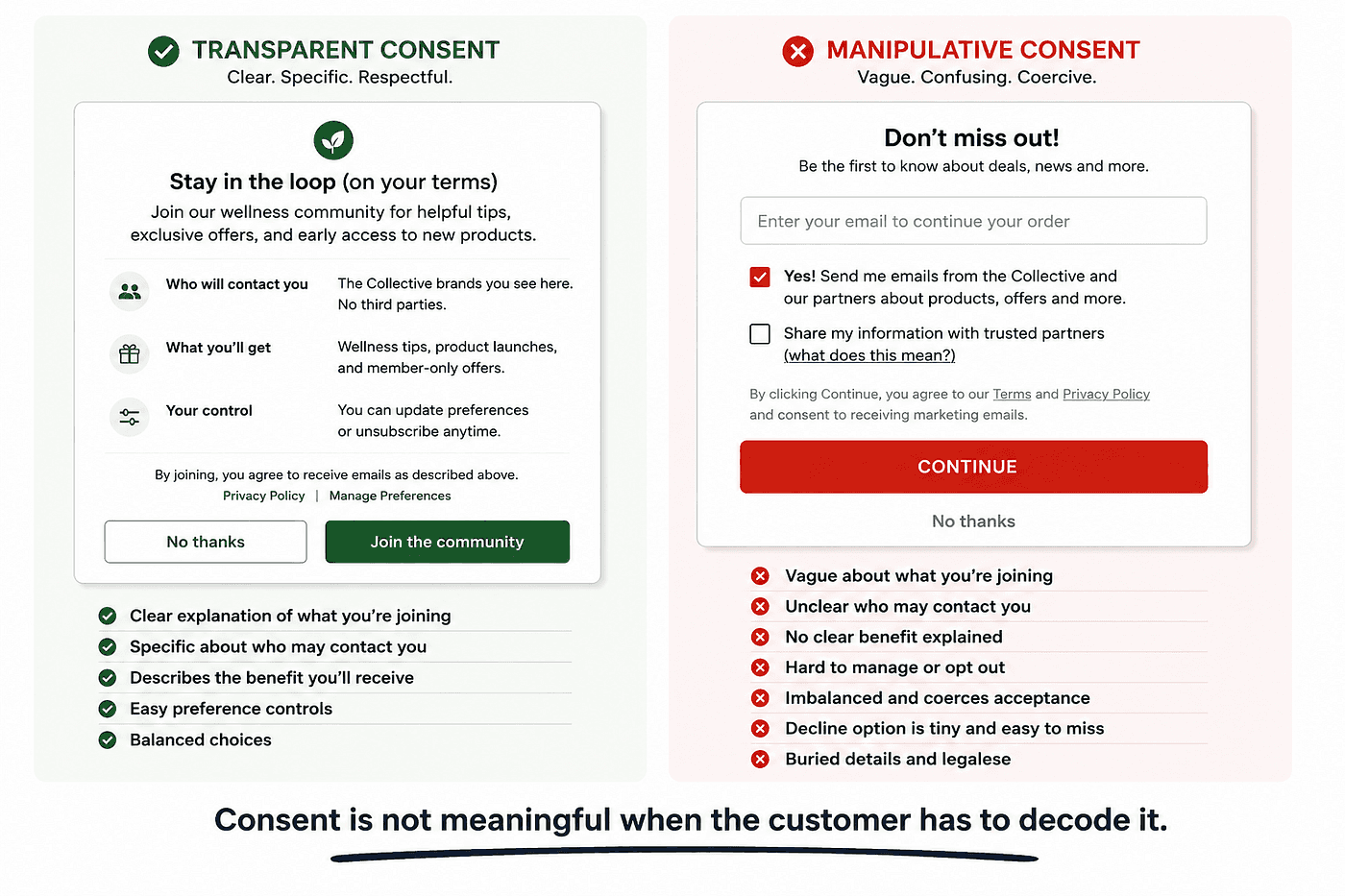
A high opt-in rate is not permission to weaken consent
Successful conversion metrics have a peculiar effect on product teams. Once an interaction performs well, people begin looking for ways to make it perform even better — often by removing precisely the clarity and autonomy that made the original decision trustworthy.
The Federal Trade Commission describes dark patterns as design practices that can “trick or manipulate consumers into buying products or services or giving up their privacy.” [4]
That is not an acceptable path to a higher opt-in rate. It is also a good way to turn a promising acquisition experience into a long-term unsubscribe and reputation problem.
A meaningful opt-in requires customers to understand:
what they are joining;
why the invitation is appearing;
what benefit they will receive;
which kinds of brands are involved;
what communications may follow; and
how they can change their preferences later.
Customer control was not a minor detail in our research. In five exploratory customer interviews, every participant said they were open to receiving communications from partner brands, provided the messages remained useful and they retained control over their subscriptions. That qualifier is part of the result. Removing it would not create a stronger finding. It would create a less accurate one.
Why the 45% opt-in rate should not be reduced to “post-checkout works”
Post-checkout is a strong moment because the customer has completed the primary task and established a relationship with the brand. But “put it after checkout” is not a transferable strategy by itself. A post-checkout experience can still fail when it:
bears no clear relationship to the purchase;
presents too many choices;
makes the commercial arrangement more visible than the customer benefit;
asks for information without explaining its use;
disguises an advertising placement as an independent recommendation;
introduces brands that weaken the originating brand’s credibility; or
treats a completed purchase as blanket consent for future marketing.
The moment creates potential. The design decides whether that potential becomes trust or extraction.
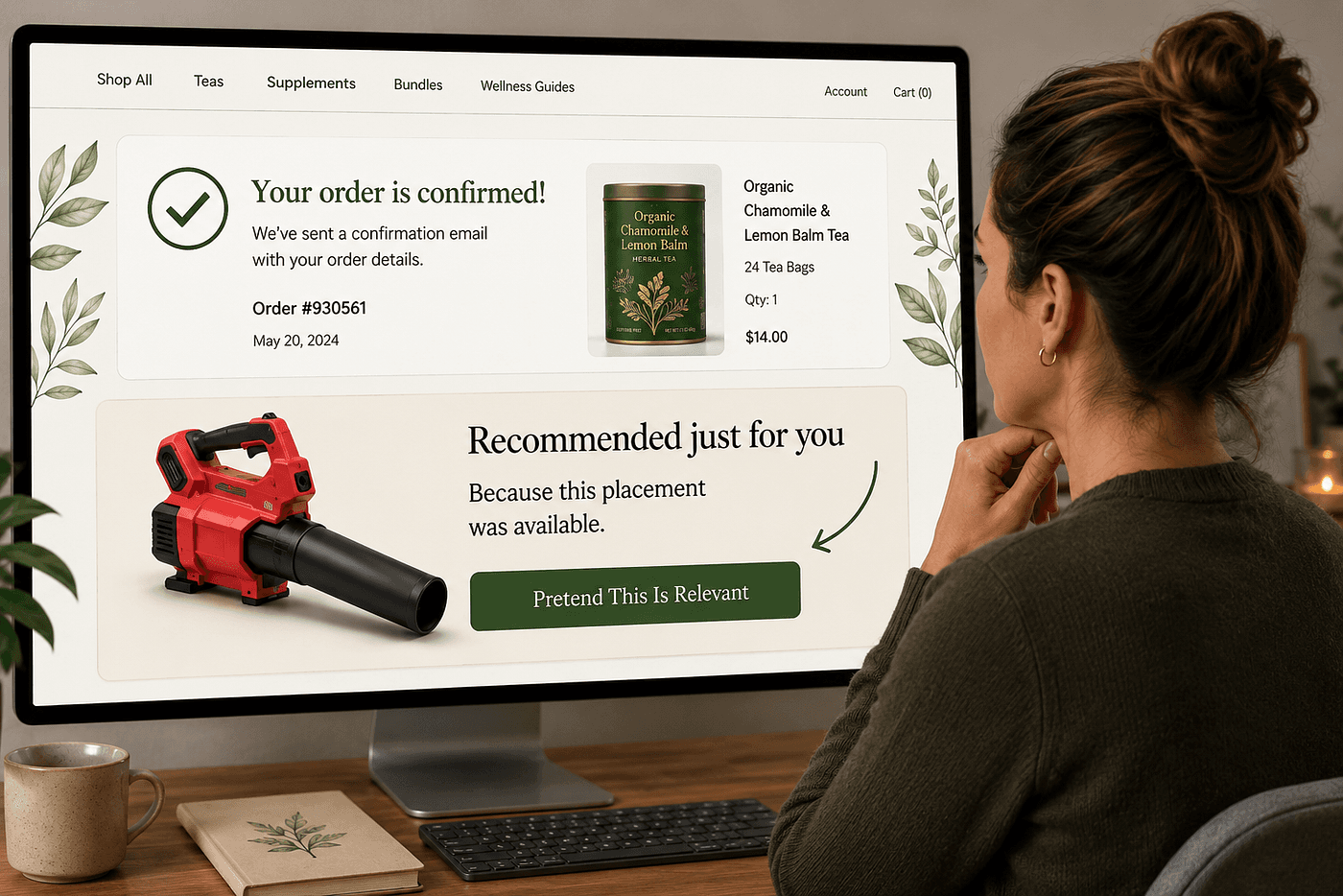
This distinction matters across product categories. A marketplace can introduce other sellers after a purchase, but the recommendation has to belong in the experience the buyer just chose. A healthcare platform can suggest related services after an appointment, but the use of patient information must remain appropriate to the care context. A SaaS product can recommend an integration after a workflow is completed, but the integration must solve a recognizable next problem.
In each case, the product team is making the same decision: Does the next recommendation belong in the experience the customer just chose, or are we using a moment of reduced friction to insert our own agenda?
Customers can generally tell the difference. They may not describe it in those terms. They may simply click, ignore, unsubscribe, distrust the recommendation, or leave with a slightly worse opinion of the brand.
Curation protects both sides of the trust relationship
One finding from our interviews surprised me less than it reassured me: every participant said the Collective improved or helped their perception of the originating brand. That matters because a recommendation does not affect only the brand being discovered. It also communicates something about the brand making the introduction.
A well-curated group tells the customer that the originating brand understands the broader values, interests, or needs surrounding the purchase. A badly curated group tells the customer that the brand had available inventory on a confirmation page.
Customers were also clear about the limits of useful curation. Eighty percent preferred no more than eight featured brands, with four to six emerging as the strongest range. This is a useful reminder that more choice is not automatically more value.
A Collective is not improved by filling every available slot. Curation creates meaning partly through exclusion. The customer should be able to infer why the brands belong together without conducting a small independent research project from the order-confirmation page.
The practical product test
A product team considering a post-transaction opt-in should evaluate more than the conversion rate.
Ask:
What has the customer just accomplished?
The next request should relate to the goal the customer completed, not merely to the screen that happens to appear next.
What trust has actually been earned?
A purchase establishes some confidence in the originating brand. It does not create unlimited permission to introduce unrelated parties or repurpose customer information.
Why does this request belong at this moment?
The relationship should be obvious from the customer’s perspective, not only from the company’s funnel diagram.
Is the value legible before the customer agrees?
Customers should not need to opt in before they understand the theme, benefit, or expected communication.
Does the customer retain meaningful control?
Consent weakens when joining is easy but understanding, modifying, or leaving is difficult.
Would the recommendation improve the customer’s perception of the originating product?
If not, the placement may produce a short-term action while quietly damaging the source of trust that made the action possible.
The right question is not, “How do we reproduce a 45% opt-in rate?”
The right question is, “What made this request feel appropriate enough that nearly half of customers chose it voluntarily?”
The answer is not a button color. It is the combined effect of timing, trust, thematic relevance, curation, customer benefit, and control. The interface gives those forces a visible form, but the interface did not invent them.
A 45% post-checkout opt-in rate says customers will participate when the invitation makes sense inside the relationship they have just chosen. That is a more durable product insight than “post-checkout converts.”
Frequently asked questions
What is a good post-checkout opt-in rate?
Why are customers more likely to opt in after checkout?
What does context mean in post-checkout UX?
How does brand trust affect email opt-in rates?
Can one brand transfer customer trust to another brand?
How should brands design a trustworthy post-checkout opt-in?
The Role of Trust in Post-Checkout Brand Discovery
When 45% of customers voluntarily opted into a Collective Acquisition Channel after completing a purchase, the obvious interpretation was that the offer converted well.
That interpretation is accurate. It is also the least interesting thing about the number.
A conversion rate tells us what people did. A useful product analysis asks why the decision made sense to them at that particular moment, inside that particular relationship, with that particular request.
Across seven participating DTC brands, 45% of eligible customers chose to join a Collective after checkout. 40% clicked through to explore a participating partner brand. More than 2,000 customer emails were generated through the experience. These are Riplz platform observations, not projections or survey responses.
The opt-in rate is evidence that customer permission is not a fixed trait. It is contextual. People are not simply “willing” or “unwilling” to subscribe, share information, explore another brand, or accept a recommendation. Their response depends on who is asking, why the request is being made, what just happened, and whether the next action feels consistent with the experience they chose.
That is a product architecture problem disguised as a marketing metric.
The transaction changes the meaning of the request
Before checkout, the customer is still evaluating risk.
They are judging the product, the price, the brand, the delivery promise, the return policy, and whether the entire site looks as though it was assembled by adults. Every additional request competes with the primary job: deciding whether to buy.
After checkout, the relationship has changed. The customer has selected the brand, paid for the product, and received confirmation that the transaction succeeded. The brand is no longer an unknown merchant asking for attention. It is the company the customer just trusted with money, personal information, and the expectation that something will arrive at their home.
That does not mean the customer has entered a temporary state of marketing hypnosis. It means the interaction has acquired context.
The next request is interpreted through the decision that immediately preceded it. A post-checkout invitation from the brand a customer just chose does not carry the same meaning as a pop-up shown three seconds after the customer arrived from a search result. The interface may contain the same email field and the same button, but behaviorally, they are different products.
This is why optimizing the words on the button while ignoring the moment around it misses most of the problem.
What is a Collective Acquisition Channel?
A Collective Acquisition Channel is a customer-acquisition model in which aligned brands help customers discover one another through trusted, customer-facing relationships rather than through conventional paid targeting.
In the Riplz experience, a customer may encounter a Collective placement after purchasing from a participating brand. The invitation connects that purchase to a curated group of other brands organized around a relevant shared theme.
The important product principle is not that something appears after checkout. Plenty of things appear after checkout. Most of them are order numbers, shipping details, account prompts, upsells, surveys, referral requests, app-download pitches, and whatever else the growth team managed to fit onto the page before someone from UX noticed.
The principle is that the invitation must feel like a coherent continuation of the transaction. Context does not merely surround the choice. Context helps determine what the choice means.
Trust is transferred through experience, not borrowed through placement
Trust is often discussed as though it were a decorative brand attribute: establish credibility, add social proof, use reassuring typography, and perhaps stick a shield icon somewhere near the credit-card form.
Actual trust is more demanding. Deepa Prahalad wrote in Harvard Business Review that trust is “not simply a nice thing to have, but a critical strategic asset.” [1]
The useful word there is asset. Trust produces value because it changes how people assess uncertainty. It reduces the amount of independent verification required before they act.
That is particularly relevant when one brand introduces another. The originating brand is not automatically entitled to transfer customer trust to every company willing to participate. A recommendation can strengthen trust when it feels selective and appropriate. It can also spend that trust rather quickly when the recommendation is irrelevant, excessive, or transparently transactional.
Baymard Institute’s large-scale usability research found that suggesting products without an obvious relationship to the cart “can erode a user’s confidence in the site, and all of its recommendations — even relevant ones.” [2]
That erosion reaches beyond the irrelevant recommendation itself. Baymard notes that it can undermine confidence in relevant recommendations too.
This is the expensive part of getting curation wrong. A poorly matched placement does not merely fail to convert. It teaches the customer that the surrounding recommendation system is not worth their attention.
The 45% opt-in rate therefore cannot be explained by location alone. Post-checkout created the opportunity, but relevance and curation helped make the invitation credible.
The customer must understand why the invitation belongs there
In customer interviews I conducted for Riplz, 91% of participants said they preferred discovering new brands through brands they already trusted. Every participant encountered at least one brand they had not previously known, and every participant expressed interest or openness to discovering new brands through the Collective.
Those results support a straightforward behavioral model:
Known brand + relevant context + credible curation = lower uncertainty around unfamiliar brands.
The known brand provides the starting trust. The shared theme explains why the brands appear together. The curation implies that someone exercised judgment instead of simply selling the available space.
The incentive still matters. In five detailed interviews, every participant said both the shared theme and the opportunity to save mattered. Customers do not become morally opposed to discounts simply because the experience has a coherent narrative.
But the incentive was not operating alone. One participant described the post-purchase experience this way:
“It felt like it was a natural conversion, not a marketing push.”
Another called it “seamless.”
The second comment is particularly irritating to a product person because “seamless” is the word everyone uses when they do not want to explain what actually worked. In this case, the first participant did explain it: the invitation felt like a natural continuation of the customer’s action rather than an interruption inserted to serve the company.
That distinction is the entire argument.
Context determines whether information use feels appropriate
The relationship between context, trust, and information sharing is not limited to ecommerce opt-ins.
A study published in the Journal of Consumer Research examined how consumers responded when companies explained why they were seeing targeted advertising. The researchers found that consumers judged information flows partly according to whether data was obtained inside or outside the site and whether the customer had stated the information or the company had inferred it. [3]
The study’s abstract states that “when consumers trust a platform, revealing acceptable information flows increases ad effectiveness.” [3]
The operative phrase is acceptable information flows. Transparency does not rescue an interaction that violates the customer’s expectations. Explaining an inappropriate use of information can simply make the problem more obvious. Trust helps when the underlying action already fits the context.
This applies directly to post-checkout consent. A customer who has just purchased from a pet-care brand may reasonably understand why that brand is introducing a carefully selected group of businesses connected to animal welfare. The relationship among the purchase, the theme, the originating brand, and the invitation is legible.
A customer who buys the same product and immediately receives a vaguely worded request allowing unrelated companies to contact them is being asked to perform a very different mental calculation.
Same page position. Different information flow.
A high opt-in rate is not permission to weaken consent
Successful conversion metrics have a peculiar effect on product teams. Once an interaction performs well, people begin looking for ways to make it perform even better — often by removing precisely the clarity and autonomy that made the original decision trustworthy.
The Federal Trade Commission describes dark patterns as design practices that can “trick or manipulate consumers into buying products or services or giving up their privacy.” [4]
That is not an acceptable path to a higher opt-in rate. It is also a good way to turn a promising acquisition experience into a long-term unsubscribe and reputation problem.
A meaningful opt-in requires customers to understand:
what they are joining;
why the invitation is appearing;
what benefit they will receive;
which kinds of brands are involved;
what communications may follow; and
how they can change their preferences later.
Customer control was not a minor detail in our research. In five exploratory customer interviews, every participant said they were open to receiving communications from partner brands, provided the messages remained useful and they retained control over their subscriptions. That qualifier is part of the result. Removing it would not create a stronger finding. It would create a less accurate one.
Why the 45% opt-in rate should not be reduced to “post-checkout works”
Post-checkout is a strong moment because the customer has completed the primary task and established a relationship with the brand. But “put it after checkout” is not a transferable strategy by itself. A post-checkout experience can still fail when it:
bears no clear relationship to the purchase;
presents too many choices;
makes the commercial arrangement more visible than the customer benefit;
asks for information without explaining its use;
disguises an advertising placement as an independent recommendation;
introduces brands that weaken the originating brand’s credibility; or
treats a completed purchase as blanket consent for future marketing.
The moment creates potential. The design decides whether that potential becomes trust or extraction.
This distinction matters across product categories. A marketplace can introduce other sellers after a purchase, but the recommendation has to belong in the experience the buyer just chose. A healthcare platform can suggest related services after an appointment, but the use of patient information must remain appropriate to the care context. A SaaS product can recommend an integration after a workflow is completed, but the integration must solve a recognizable next problem.
In each case, the product team is making the same decision: Does the next recommendation belong in the experience the customer just chose, or are we using a moment of reduced friction to insert our own agenda?
Customers can generally tell the difference. They may not describe it in those terms. They may simply click, ignore, unsubscribe, distrust the recommendation, or leave with a slightly worse opinion of the brand.
Curation protects both sides of the trust relationship
One finding from our interviews surprised me less than it reassured me: every participant said the Collective improved or helped their perception of the originating brand. That matters because a recommendation does not affect only the brand being discovered. It also communicates something about the brand making the introduction.
A well-curated group tells the customer that the originating brand understands the broader values, interests, or needs surrounding the purchase. A badly curated group tells the customer that the brand had available inventory on a confirmation page.
Customers were also clear about the limits of useful curation. Eighty percent preferred no more than eight featured brands, with four to six emerging as the strongest range. This is a useful reminder that more choice is not automatically more value.
A Collective is not improved by filling every available slot. Curation creates meaning partly through exclusion. The customer should be able to infer why the brands belong together without conducting a small independent research project from the order-confirmation page.
The practical product test
A product team considering a post-transaction opt-in should evaluate more than the conversion rate.
Ask:
What has the customer just accomplished?
The next request should relate to the goal the customer completed, not merely to the screen that happens to appear next.
What trust has actually been earned?
A purchase establishes some confidence in the originating brand. It does not create unlimited permission to introduce unrelated parties or repurpose customer information.
Why does this request belong at this moment?
The relationship should be obvious from the customer’s perspective, not only from the company’s funnel diagram.
Is the value legible before the customer agrees?
Customers should not need to opt in before they understand the theme, benefit, or expected communication.
Does the customer retain meaningful control?
Consent weakens when joining is easy but understanding, modifying, or leaving is difficult.
Would the recommendation improve the customer’s perception of the originating product?
If not, the placement may produce a short-term action while quietly damaging the source of trust that made the action possible.
The right question is not, “How do we reproduce a 45% opt-in rate?”
The right question is, “What made this request feel appropriate enough that nearly half of customers chose it voluntarily?”
The answer is not a button color. It is the combined effect of timing, trust, thematic relevance, curation, customer benefit, and control. The interface gives those forces a visible form, but the interface did not invent them.
A 45% post-checkout opt-in rate says customers will participate when the invitation makes sense inside the relationship they have just chosen. That is a more durable product insight than “post-checkout converts.”
Frequently asked questions
What is a good post-checkout opt-in rate?
Why are customers more likely to opt in after checkout?
What does context mean in post-checkout UX?
How does brand trust affect email opt-in rates?
Can one brand transfer customer trust to another brand?
How should brands design a trustworthy post-checkout opt-in?
Bring Passion. Get Growth, Support.



Where Ecommerce Brands Grow Together
Riplz connects values-aligned brands into Collectives that drive emails, sales, and lasting customer relationships
Book a Demo
Where Ecommerce Brands Grow Together
Riplz connects values-aligned brands into Collectives that drive emails, sales, and lasting customer relationships
Book a Demo
Where Ecommerce Brands Grow Together
Riplz connects values-aligned brands into Collectives that drive emails, sales, and lasting customer relationships
Book a Demo