
Marketing
What Is a Collective Acquisition Channel? A New Model for Ecommerce Customer Acquisition
What Is a Collective Acquisition Channel? A New Model for Ecommerce Customer Acquisition
Paid acquisition rents attention from platforms. A Collective Acquisition Channel routes the trust brands have already earned toward customer discovery.
Ecommerce has no shortage of ways to reach the same increasingly expensive customer. Brands buy attention through Meta, Google, TikTok, influencers, affiliates, sponsorships, retargeting, email, SMS, and the occasional marketing experiment everyone agrees not to mention again after the quarterly review. Most of those efforts fit into three familiar categories:
Paid acquisition rents access to an audience.
Owned acquisition works the audience a brand has already built.
Earned acquisition depends on reputation, advocacy, or media attention.
There is another source of customer discovery sitting in plain sight: the trusted relationships customers already have with the brands they buy from.
A customer who buys premium dog food may also need grooming products, travel accessories, supplements, beds, training tools, and pet-safe household products. The companies serving those needs may share a customer without selling the same thing.
A customer who chooses deodorant from a sustainable brand because they want their purchases to reflect their environmental values may also prefer tea, slippers, and toiletries from companies that share the same commitment to the planet.
Brands have always found informal ways to act on that overlap. They negotiate one-off partnerships, trade email placements, create affiliate links, partner on campaigns to generate donations to the same nonprofits, cross-sell products, organize giveaways, and maintain spreadsheets whose filenames eventually contain the word final three times.
What they have not had is a structured customer acquisition channel built around trusted, mutually approved groups of brands with a single theme.
That is the purpose of a Collective Acquisition Channel.
What is a Collective Acquisition Channel?
A Collective Acquisition Channel is a customer acquisition model in which compatible brands introduce customers to one another through curated groups.
Each group is called a Collective. Customers encounter the group through a Collective placement, typically after completing a purchase from one of the participating brands. They can then discover and choose offers from other companies relevant to the same interest, theme, cause or context.
The brand where the customer journey begins — the “originating brand” — creates the path. And the trust. The other participating brands provide the next relevant destinations. The customer decides which path to take first in their journey of trust-based discovery.
Unlike a paid advertising network, brands do not buy visibility through bids or audience targeting. Unlike a conventional affiliate program, the experience is not primarily a publisher sending tracked traffic to a merchant. Unlike a sweepstakes, the customer is not exchanging an email address for the possibility of winning an unrelated prize.
A Collective Acquisition Channel begins with a real purchase and an existing brand relationship. The originating brand has already earned the customer’s attention. The Collective uses that moment to create a curated introduction — not another ad impression.
What is a brand Collective?
A Collective is a small group of complementary brands organized around a shared theme.
A dog-focused Collective might include brands selling grooming products, treats, accessories, supplements, and household products for pet owners.
An environment Collective might gather brands around the shared goal of supporting the environment.
The companies do not need to sell similar products. They need a recognizable reason to appear together from the customer’s point of view.
That reason might be:
A shared activity
A practical need
A stage of life
A customer identity
A set of values
A shared cause
A recurring use context
The theme gives the group meaning. Curation gives it credibility.
In ecommerce shopper research conducted for Riplz in 2025, 91% of participants said they preferred to discover new brands through brands they already trusted. Every participant encountered at least one brand they had not previously known, and every participant expressed interest or openness to discovering brands through the Collective.
Observed behavior supported what customers told us: across seven DTC brands participating in Collectives, 40% of customers clicked through to explore a partner brand.
The shared theme did more than make the group understandable. It gave customers a reason to continue exploring.
But interest was not unlimited. Eighty percent preferred a featured group of no more than eight brands, with four to six emerging as the ideal range.
That distinction matters. A Collective is not a directory. The goal is not to place as many logos as possible in front of a customer while the transaction is still warm. The group should feel deliberately selected — curated enough to invite exploration rather than demand attention.
One participant described the appeal as quietly discovering a few complementary brands while relaxing with tea at home:
“It becomes much more like an intimate relationship… You think of sitting on a mountaintop in the Himalayas — or looking out your back window — and just breathing.”
My own online shopping has rarely achieved Himalayan transcendence, but this established a useful — and unexpectedly high — bar for the experience. Too many brands would destroy that feeling:
“When you’re inundated with 30 different companies in your face, it takes away from that relaxation.”
The product goal is useful discovery without cognitive sprawl: enough relevance to invite exploration, but not so much visual and commercial noise that the customer starts longing for the mountaintop.
What does a Collective placement look like?
A Collective placement appears after a customer completes a purchase. By that point, the customer has already:
Chosen a product
Evaluated the brand
Accepted the price
Completed payment
Established a commercial relationship
In other words, the brand has done the difficult part: convinced a person to trust it with both money and a shipping address.
Post-purchase pages are not empty territory. Many ecommerce brands already use them to recommend additional products, cross-sell subscriptions, or display offers from other companies.
The problem is not that brands have failed to notice the space. It is that many post-purchase recommendations still arrive as isolated offers: a product tile, a discount, or an ad selected because the customer might click it. The offer may be relevant, but the customer is rarely given a clear reason why that company belongs in the experience, or why the brand they just trusted chose to introduce it.
A surprising number of post-purchase experiences respond to hard-won customer trust by immediately filling the page with the digital equivalent of things found near the register.
A Collective placement takes a different approach. It introduces a small, curated group of complementary brands while the customer still has context for the purchase they just made. Instead of presenting each company as a disconnected promotion, it explains the shared theme that brings them together and why that theme may matter to the customer.
The customer might see:
The Collective’s shared theme
A short explanation of why the brands have come together
The participating brands
Relevant offers
Clear information about what happens if the customer joins
Controls over which brands the customer wants to hear from
That distinction changes the UX. The post-purchase page stops behaving like leftover ad inventory and starts functioning as a continuation of the customer relationship the brand just worked so hard to earn.
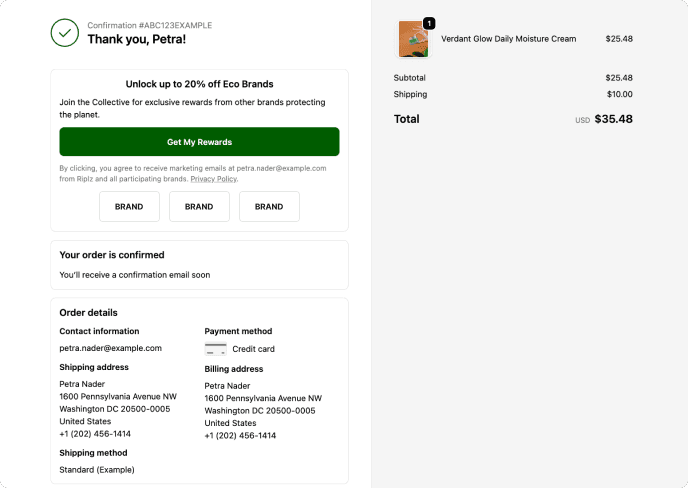
A Collective placement introduces a small group through a shared theme, rather than presenting each company as an isolated post-purchase promotion.
A conventional post-purchase ad asks the customer to evaluate another offer. A Collective placement gives the customer a clear reason the brands belong together. The shared theme connects them to an interest, value, identity, or need the customer has already expressed through the purchase they just completed and the choice of brand they chose to purchase from.
That context matters because the originating brand has already earned the customer’s trust. By introducing a small group of brands around a theme the customer recognizes, the placement extends that trust into discovery. It should feel like the brand saying, “If this matters to you, these companies may matter too” — not like a block of unrelated ads attached to the confirmation page after everyone responsible for the customer experience went home.
One participant in our research described the difference directly:
“It felt like it was a natural conversion, not a marketing push.”
That sentence captures the UX problem better than most diagrams could. The placement works when the customer can immediately understand why the brands are there. It fails when relevance exists only inside the targeting logic and never becomes visible in the experience.
Why would customers discover brands through other brands?
Customers do not experience every brand as an isolated commercial entity. They use known brands as evidence. A company they have already purchased from tells them something about product quality, price, aesthetic, reliability, identity, or values. When that company introduces another brand, some of that judgment travels with the introduction.
Edelman’s 2025 Brand Trust research found that 80% of respondents trusted the brands they used. The study also found that trust had become as important to purchase consideration as price and quality. [1] That trust can reduce some of the uncertainty surrounding an unfamiliar company.
One Riplz research participant explained:
“I never would have discovered these smaller brands if I hadn’t started with Pride+Groom.”
She did not begin by searching for an unknown independent brand. She began with a company she already knew. That relationship created the path into discovery. Trust can create attention. Relevance and curation determine what happens next.
A brand introduction transfers judgment as well as traffic
The same mechanism that makes trusted discovery valuable also makes it risky. A well-chosen Collective can strengthen the originating brand’s position by demonstrating taste, relevance, and an understanding of the customer. A poorly chosen group can make the company look careless.
That risk already exists in post-purchase cross-selling. Ad networks and affiliate systems can place third-party brands into the customer journey, but the placement is often optimized around predicted clicks, conversion, or available inventory — not whether the brands form a coherent group around the customer’s values, interests, or reason for purchasing.
The merchant may have some control over categories or individual advertisers, but little guidance for judging the complete association the customer will see. Relevance inside the targeting system does not automatically become coherence in the customer experience.
Research into brand alliances has repeatedly found that consumer attitudes can transfer between participating brands. Bernard Simonin and Julie Ruth’s foundational study asked whether a company becomes “known by the company it keeps” and found that attitudes toward an alliance can influence perceptions of its participants. [2]
A post-purchase placement therefore does more than distribute traffic. It creates a visible association, and the originating brand receives part of the credit or blame for that association whether it selected the company deliberately or an advertising system selected it on the brand’s behalf.
Every company shown contributes to the meaning of the experience. A low-quality, irrelevant, directly competitive, or badly positioned brand can affect how customers interpret the merchant that introduced it.
A Collective addresses that risk by organizing discovery around a shared theme and treating curation as a product requirement rather than an incidental outcome of targeting. The question is not only whether a customer might click an offer. It is whether the originating brand would knowingly place that company inside the relationship it has just established with the customer.
This is why a Collective cannot consist of every company willing to participate. The customer sees a contextual group. The product has to design one.
How is a Collective Acquisition Channel different from existing channels?
A Collective Acquisition Channel may resemble several familiar models from a distance. The underlying mechanics are different.
It is not an ad network
An ad network sells access to attention. Advertisers pay to reach audiences selected through targeting, context, behavior, or predicted interest.
A Collective relies on reciprocal participation between brands.
The originating company is not selling its confirmation page to the highest bidder. It is introducing customers to a curated group of companies it has agreed to appear beside for a reason.
Exposure comes from participation in the Collective and from real customer activity, not simply from paying more for the placement.
It is not a conventional affiliate network
Affiliate systems typically connect merchants with publishers, creators, media companies, review sites, or other traffic sources.
A Collective connects brands that serve overlapping customer contexts.
Each brand has its own customer relationship, placement, preferences, restrictions, and performance outcomes. The value can move in more than one direction: a brand can introduce customers to Collective participants while gaining exposure through those participants.
Attribution is part of the system.
It is not the whole system.
It is not a sweepstakes
A sweepstakes can generate a large email list because people want the prize. That does not necessarily mean they want the brands.
A Collective asks the customer to explore companies in the context of a purchase, a shared interest, shared values, and a practical offer.
The customer has seen the brand in context and chosen to continue.
That is not a guarantee of a purchase. It is simply a more informative behavioral signal than appearing on a bulk entry list.
Collective formation is not the same as similarity matching. The products may differ. The reason they appear together should not.
What is Collective formation?
Collective formation is the process of deciding which brands belong together in a Collective.
At first, that sounds like a familiar matching exercise:
Find brands serving similar customers.
Group them around a shared theme.
Introduce them after purchase.
Then similarity meets reality and becomes considerably less helpful. Brands can share an audience without belonging together. They may compete directly, occupy completely different positions, or form a group that feels like someone searched a spreadsheet for “women, 25–54” and called it curation.
The question is not simply whether the brands resemble one another. It is whether the complete group makes emotional and practical sense to the customer.
The shared theme gives the Collective that meaning. It connects the brands to an interest, value, cause, identity, or need the customer already cares about. Someone who buys sustainable deodorant may not want more deodorant. They may want tea, slippers, and toiletries from companies that reflect the same environmental values.
The products do not have to resemble one another. The reason for choosing them should. Customers see one group and immediately draw conclusions about why those companies have appeared together. The association either feels intentional or it does not.
Collective formation is not about assembling the companies that look most alike. It is about forming a group that means something.
Why is Collective formation a product problem?
Manual brand relationships can rely heavily on people carrying context in their heads. Someone remembers that two companies compete. Someone else knows that a particular association was approved only for a certain campaign. A shared document explains which offers remain current. A Slack message contains the reasoning behind a decision nobody thought would still matter six months later.
This works at small scale because people compensate for the absence of product structure. As the number of participating brands and customer experiences grows, curation cannot depend entirely on institutional memory. A scalable Collective Acquisition Channel needs a dependable way to preserve the judgment that made the group feel intentional in the first place.
That does not mean reducing every brand decision to a similarity score. It means recognizing that curation is part of the product, not a manual step completed before the “real” product begins.
The visible experience may be simple: a customer encounters a small group of complementary brands connected by a shared theme.
The difficult part is making sure the experience continues to feel deliberate as brands, offers, and circumstances change.
The customer experience is simple. The product problem is not.
At Riplz, we built the Collective Acquisition Channel for DTC brands on Shopify.
The customer-facing experience is simple: after completing a purchase, a customer encounters a small group of complementary brands organized around a shared theme. That theme connects to an interest, value, identity, or need the customer has already expressed through their trust in the originating brand , and extends that trust into discovery of partner brands.
Participating companies gain a measurable path to Collective-driven leads and Collective-driven revenue through brands customers already trust.
That is the simple version.
When I began writing the product specifications, I had to solve for everything underneath it. How do we support ongoing brand curation while preserving a coherent experience for the customer? How do we preserve the feeling that every brand has a reason to be there? How do we keep the group useful as brands, offers, and customer expectations evolve? How do we make brand judgment scalable without replacing it with a score that mistakes similarity for compatibility?
And how do we do all of that without causing the engineering team to quietly update their LinkedIn profiles to ‘open to work’?
Customers see a small group of brands. The product must understand enough about the surrounding system to keep that group intentional.
The customer does not see those questions. They see a group of brands and make an immediate judgment about whether the association feels thoughtful, trustworthy, and relevant to them. That made Collective formation more than a matching feature. It became a curation problem, a multi-stakeholder product problem, and ultimately a trust problem.
The customer sees a group.
My job was to define the product requirements that would help the group feel intentional.
That is the central challenge of Collective formation — and where this series goes next.
What Is a Collective Acquisition Channel? A New Model for Ecommerce Customer Acquisition
Paid acquisition rents attention from platforms. A Collective Acquisition Channel routes the trust brands have already earned toward customer discovery.
Ecommerce has no shortage of ways to reach the same increasingly expensive customer. Brands buy attention through Meta, Google, TikTok, influencers, affiliates, sponsorships, retargeting, email, SMS, and the occasional marketing experiment everyone agrees not to mention again after the quarterly review. Most of those efforts fit into three familiar categories:
Paid acquisition rents access to an audience.
Owned acquisition works the audience a brand has already built.
Earned acquisition depends on reputation, advocacy, or media attention.
There is another source of customer discovery sitting in plain sight: the trusted relationships customers already have with the brands they buy from.
A customer who buys premium dog food may also need grooming products, travel accessories, supplements, beds, training tools, and pet-safe household products. The companies serving those needs may share a customer without selling the same thing.
A customer who chooses deodorant from a sustainable brand because they want their purchases to reflect their environmental values may also prefer tea, slippers, and toiletries from companies that share the same commitment to the planet.
Brands have always found informal ways to act on that overlap. They negotiate one-off partnerships, trade email placements, create affiliate links, partner on campaigns to generate donations to the same nonprofits, cross-sell products, organize giveaways, and maintain spreadsheets whose filenames eventually contain the word final three times.
What they have not had is a structured customer acquisition channel built around trusted, mutually approved groups of brands with a single theme.
That is the purpose of a Collective Acquisition Channel.
What is a Collective Acquisition Channel?
A Collective Acquisition Channel is a customer acquisition model in which compatible brands introduce customers to one another through curated groups.
Each group is called a Collective. Customers encounter the group through a Collective placement, typically after completing a purchase from one of the participating brands. They can then discover and choose offers from other companies relevant to the same interest, theme, cause or context.
The brand where the customer journey begins — the “originating brand” — creates the path. And the trust. The other participating brands provide the next relevant destinations. The customer decides which path to take first in their journey of trust-based discovery.
Unlike a paid advertising network, brands do not buy visibility through bids or audience targeting. Unlike a conventional affiliate program, the experience is not primarily a publisher sending tracked traffic to a merchant. Unlike a sweepstakes, the customer is not exchanging an email address for the possibility of winning an unrelated prize.
A Collective Acquisition Channel begins with a real purchase and an existing brand relationship. The originating brand has already earned the customer’s attention. The Collective uses that moment to create a curated introduction — not another ad impression.
What is a brand Collective?
A Collective is a small group of complementary brands organized around a shared theme.
A dog-focused Collective might include brands selling grooming products, treats, accessories, supplements, and household products for pet owners.
An environment Collective might gather brands around the shared goal of supporting the environment.
The companies do not need to sell similar products. They need a recognizable reason to appear together from the customer’s point of view.
That reason might be:
A shared activity
A practical need
A stage of life
A customer identity
A set of values
A shared cause
A recurring use context
The theme gives the group meaning. Curation gives it credibility.
In ecommerce shopper research conducted for Riplz in 2025, 91% of participants said they preferred to discover new brands through brands they already trusted. Every participant encountered at least one brand they had not previously known, and every participant expressed interest or openness to discovering brands through the Collective.
Observed behavior supported what customers told us: across seven DTC brands participating in Collectives, 40% of customers clicked through to explore a partner brand.
The shared theme did more than make the group understandable. It gave customers a reason to continue exploring.
But interest was not unlimited. Eighty percent preferred a featured group of no more than eight brands, with four to six emerging as the ideal range.
That distinction matters. A Collective is not a directory. The goal is not to place as many logos as possible in front of a customer while the transaction is still warm. The group should feel deliberately selected — curated enough to invite exploration rather than demand attention.
One participant described the appeal as quietly discovering a few complementary brands while relaxing with tea at home:
“It becomes much more like an intimate relationship… You think of sitting on a mountaintop in the Himalayas — or looking out your back window — and just breathing.”
My own online shopping has rarely achieved Himalayan transcendence, but this established a useful — and unexpectedly high — bar for the experience. Too many brands would destroy that feeling:
“When you’re inundated with 30 different companies in your face, it takes away from that relaxation.”
The product goal is useful discovery without cognitive sprawl: enough relevance to invite exploration, but not so much visual and commercial noise that the customer starts longing for the mountaintop.
What does a Collective placement look like?
A Collective placement appears after a customer completes a purchase. By that point, the customer has already:
Chosen a product
Evaluated the brand
Accepted the price
Completed payment
Established a commercial relationship
In other words, the brand has done the difficult part: convinced a person to trust it with both money and a shipping address.
Post-purchase pages are not empty territory. Many ecommerce brands already use them to recommend additional products, cross-sell subscriptions, or display offers from other companies.
The problem is not that brands have failed to notice the space. It is that many post-purchase recommendations still arrive as isolated offers: a product tile, a discount, or an ad selected because the customer might click it. The offer may be relevant, but the customer is rarely given a clear reason why that company belongs in the experience, or why the brand they just trusted chose to introduce it.
A surprising number of post-purchase experiences respond to hard-won customer trust by immediately filling the page with the digital equivalent of things found near the register.
A Collective placement takes a different approach. It introduces a small, curated group of complementary brands while the customer still has context for the purchase they just made. Instead of presenting each company as a disconnected promotion, it explains the shared theme that brings them together and why that theme may matter to the customer.
The customer might see:
The Collective’s shared theme
A short explanation of why the brands have come together
The participating brands
Relevant offers
Clear information about what happens if the customer joins
Controls over which brands the customer wants to hear from
That distinction changes the UX. The post-purchase page stops behaving like leftover ad inventory and starts functioning as a continuation of the customer relationship the brand just worked so hard to earn.
A Collective placement introduces a small group through a shared theme, rather than presenting each company as an isolated post-purchase promotion.
A conventional post-purchase ad asks the customer to evaluate another offer. A Collective placement gives the customer a clear reason the brands belong together. The shared theme connects them to an interest, value, identity, or need the customer has already expressed through the purchase they just completed and the choice of brand they chose to purchase from.
That context matters because the originating brand has already earned the customer’s trust. By introducing a small group of brands around a theme the customer recognizes, the placement extends that trust into discovery. It should feel like the brand saying, “If this matters to you, these companies may matter too” — not like a block of unrelated ads attached to the confirmation page after everyone responsible for the customer experience went home.
One participant in our research described the difference directly:
“It felt like it was a natural conversion, not a marketing push.”
That sentence captures the UX problem better than most diagrams could. The placement works when the customer can immediately understand why the brands are there. It fails when relevance exists only inside the targeting logic and never becomes visible in the experience.
Why would customers discover brands through other brands?
Customers do not experience every brand as an isolated commercial entity. They use known brands as evidence. A company they have already purchased from tells them something about product quality, price, aesthetic, reliability, identity, or values. When that company introduces another brand, some of that judgment travels with the introduction.
Edelman’s 2025 Brand Trust research found that 80% of respondents trusted the brands they used. The study also found that trust had become as important to purchase consideration as price and quality. [1] That trust can reduce some of the uncertainty surrounding an unfamiliar company.
One Riplz research participant explained:
“I never would have discovered these smaller brands if I hadn’t started with Pride+Groom.”
She did not begin by searching for an unknown independent brand. She began with a company she already knew. That relationship created the path into discovery. Trust can create attention. Relevance and curation determine what happens next.
A brand introduction transfers judgment as well as traffic
The same mechanism that makes trusted discovery valuable also makes it risky. A well-chosen Collective can strengthen the originating brand’s position by demonstrating taste, relevance, and an understanding of the customer. A poorly chosen group can make the company look careless.
That risk already exists in post-purchase cross-selling. Ad networks and affiliate systems can place third-party brands into the customer journey, but the placement is often optimized around predicted clicks, conversion, or available inventory — not whether the brands form a coherent group around the customer’s values, interests, or reason for purchasing.
The merchant may have some control over categories or individual advertisers, but little guidance for judging the complete association the customer will see. Relevance inside the targeting system does not automatically become coherence in the customer experience.
Research into brand alliances has repeatedly found that consumer attitudes can transfer between participating brands. Bernard Simonin and Julie Ruth’s foundational study asked whether a company becomes “known by the company it keeps” and found that attitudes toward an alliance can influence perceptions of its participants. [2]
A post-purchase placement therefore does more than distribute traffic. It creates a visible association, and the originating brand receives part of the credit or blame for that association whether it selected the company deliberately or an advertising system selected it on the brand’s behalf.
Every company shown contributes to the meaning of the experience. A low-quality, irrelevant, directly competitive, or badly positioned brand can affect how customers interpret the merchant that introduced it.
A Collective addresses that risk by organizing discovery around a shared theme and treating curation as a product requirement rather than an incidental outcome of targeting. The question is not only whether a customer might click an offer. It is whether the originating brand would knowingly place that company inside the relationship it has just established with the customer.
This is why a Collective cannot consist of every company willing to participate. The customer sees a contextual group. The product has to design one.
How is a Collective Acquisition Channel different from existing channels?
A Collective Acquisition Channel may resemble several familiar models from a distance. The underlying mechanics are different.
It is not an ad network
An ad network sells access to attention. Advertisers pay to reach audiences selected through targeting, context, behavior, or predicted interest.
A Collective relies on reciprocal participation between brands.
The originating company is not selling its confirmation page to the highest bidder. It is introducing customers to a curated group of companies it has agreed to appear beside for a reason.
Exposure comes from participation in the Collective and from real customer activity, not simply from paying more for the placement.
It is not a conventional affiliate network
Affiliate systems typically connect merchants with publishers, creators, media companies, review sites, or other traffic sources.
A Collective connects brands that serve overlapping customer contexts.
Each brand has its own customer relationship, placement, preferences, restrictions, and performance outcomes. The value can move in more than one direction: a brand can introduce customers to Collective participants while gaining exposure through those participants.
Attribution is part of the system.
It is not the whole system.
It is not a sweepstakes
A sweepstakes can generate a large email list because people want the prize. That does not necessarily mean they want the brands.
A Collective asks the customer to explore companies in the context of a purchase, a shared interest, shared values, and a practical offer.
The customer has seen the brand in context and chosen to continue.
That is not a guarantee of a purchase. It is simply a more informative behavioral signal than appearing on a bulk entry list.
Collective formation is not the same as similarity matching. The products may differ. The reason they appear together should not.
What is Collective formation?
Collective formation is the process of deciding which brands belong together in a Collective.
At first, that sounds like a familiar matching exercise:
Find brands serving similar customers.
Group them around a shared theme.
Introduce them after purchase.
Then similarity meets reality and becomes considerably less helpful. Brands can share an audience without belonging together. They may compete directly, occupy completely different positions, or form a group that feels like someone searched a spreadsheet for “women, 25–54” and called it curation.
The question is not simply whether the brands resemble one another. It is whether the complete group makes emotional and practical sense to the customer.
The shared theme gives the Collective that meaning. It connects the brands to an interest, value, cause, identity, or need the customer already cares about. Someone who buys sustainable deodorant may not want more deodorant. They may want tea, slippers, and toiletries from companies that reflect the same environmental values.
The products do not have to resemble one another. The reason for choosing them should. Customers see one group and immediately draw conclusions about why those companies have appeared together. The association either feels intentional or it does not.
Collective formation is not about assembling the companies that look most alike. It is about forming a group that means something.
Why is Collective formation a product problem?
Manual brand relationships can rely heavily on people carrying context in their heads. Someone remembers that two companies compete. Someone else knows that a particular association was approved only for a certain campaign. A shared document explains which offers remain current. A Slack message contains the reasoning behind a decision nobody thought would still matter six months later.
This works at small scale because people compensate for the absence of product structure. As the number of participating brands and customer experiences grows, curation cannot depend entirely on institutional memory. A scalable Collective Acquisition Channel needs a dependable way to preserve the judgment that made the group feel intentional in the first place.
That does not mean reducing every brand decision to a similarity score. It means recognizing that curation is part of the product, not a manual step completed before the “real” product begins.
The visible experience may be simple: a customer encounters a small group of complementary brands connected by a shared theme.
The difficult part is making sure the experience continues to feel deliberate as brands, offers, and circumstances change.
The customer experience is simple. The product problem is not.
At Riplz, we built the Collective Acquisition Channel for DTC brands on Shopify.
The customer-facing experience is simple: after completing a purchase, a customer encounters a small group of complementary brands organized around a shared theme. That theme connects to an interest, value, identity, or need the customer has already expressed through their trust in the originating brand , and extends that trust into discovery of partner brands.
Participating companies gain a measurable path to Collective-driven leads and Collective-driven revenue through brands customers already trust.
That is the simple version.
When I began writing the product specifications, I had to solve for everything underneath it. How do we support ongoing brand curation while preserving a coherent experience for the customer? How do we preserve the feeling that every brand has a reason to be there? How do we keep the group useful as brands, offers, and customer expectations evolve? How do we make brand judgment scalable without replacing it with a score that mistakes similarity for compatibility?
And how do we do all of that without causing the engineering team to quietly update their LinkedIn profiles to ‘open to work’?
Customers see a small group of brands. The product must understand enough about the surrounding system to keep that group intentional.
The customer does not see those questions. They see a group of brands and make an immediate judgment about whether the association feels thoughtful, trustworthy, and relevant to them. That made Collective formation more than a matching feature. It became a curation problem, a multi-stakeholder product problem, and ultimately a trust problem.
The customer sees a group.
My job was to define the product requirements that would help the group feel intentional.
That is the central challenge of Collective formation — and where this series goes next.
Bring Passion. Get Growth, Support.


Where Ecommerce Brands Grow Together
Riplz connects values-aligned brands into Collectives that drive emails, sales, and lasting customer relationships
Book a Demo
Where Ecommerce Brands Grow Together
Riplz connects values-aligned brands into Collectives that drive emails, sales, and lasting customer relationships
Book a Demo
Where Ecommerce Brands Grow Together
Riplz connects values-aligned brands into Collectives that drive emails, sales, and lasting customer relationships
Book a Demo